
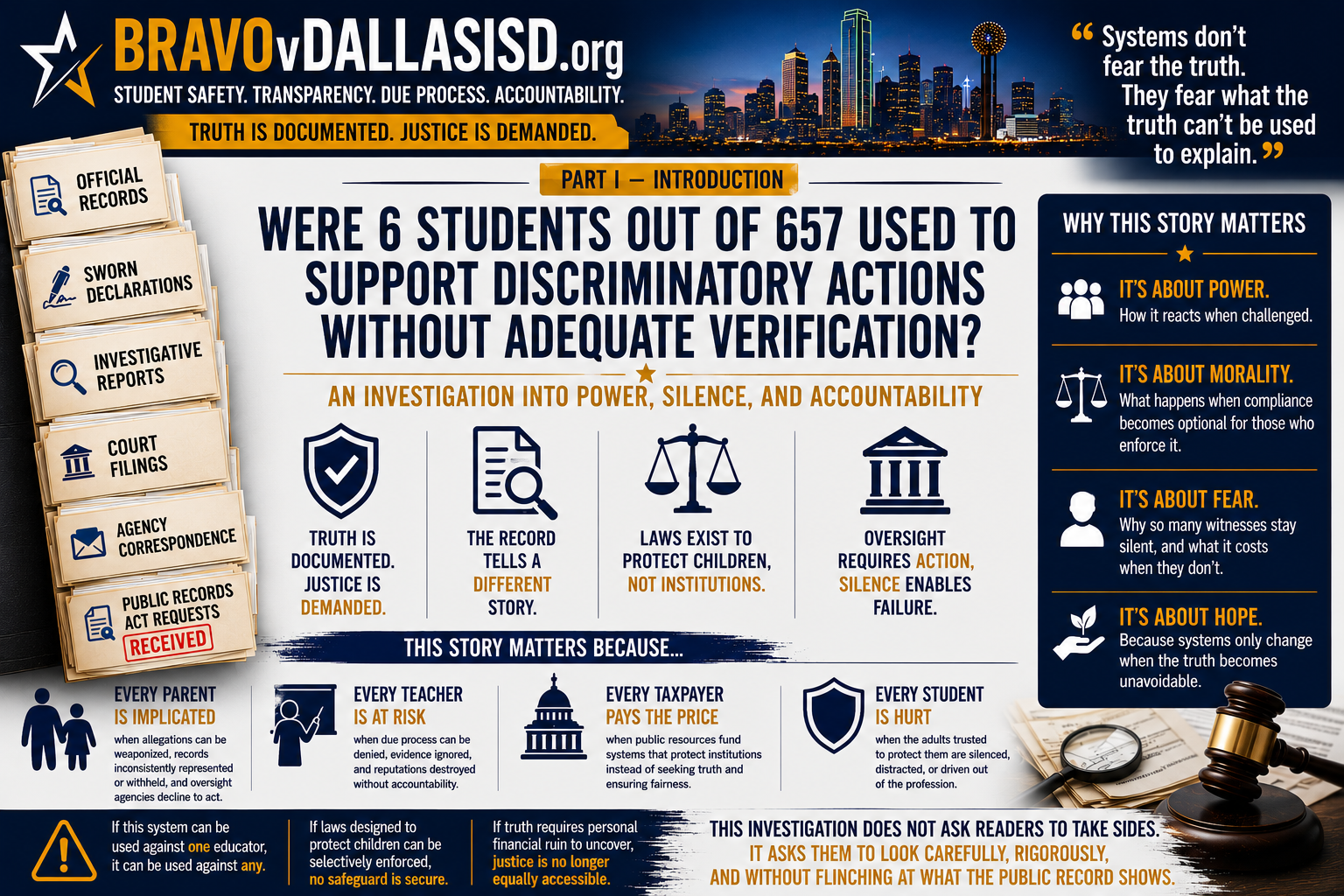
Were 6 Students Out Of 657 Used To Support Discriminatory Actions Without Adequate Verification
An Investigation Into Power, Silence, and Accountability
For four years, a Dallas public-school teacher did something most people are never supposed to do: he pursued records. Not just personal notes, nor grievances, but documents, official letters, sworn declarations, internal investigations, public-records’ responses, court filings, and agency correspondence, each one quietly contradicting the last. These records were created contemporaneously, across multiple proceedings and agencies, and long before this investigation was contemplated, forming a continuous documentary trail rather than a retrospective narrative.
Individually, they look bureaucratic. Harmless. Easy to dismiss. Together, they tell a different story.
This is the story of how Dallas ISD accused a teacher of child abuse, without vetting student statements or producing a legally valid child-protection report. How administrators cited records that state authorities later confirmed did not exist. How allegations were elevated and subjected to limited independent verification while exonerating evidence disappeared behind confidentiality laws meant to protect children not institutions. And how a system built to safeguard students may have instead been used to harm the very people sworn to protect them.
This investigation examines whether Dallas ISD developed and repeatedly deployed a pattern of administrative conduct that replaces verification with narrative, due process with delay, and accountability with silence. It is grounded exclusively in public records, sworn testimony, statutory requirements, and official agency confirmations. No anonymous sources are relied upon. No material facts are inferred without documentary support.
At its center is one educator, a Marine Corps veteran, a recognized teacher, and later a cancer patient whose insistence on following the law put him on a collision course with the institution he served for years. His actions began as routine exercises of due process and compliance obligations, and only later evolved into sustained public-interest documentation when statutory violations and procedural irregularities went unaddressed.
But this story is not just about one teacher. It is also about power, how it reacts when challenged. It is about morality, what happens when compliance becomes optional for those who enforce it. It is about fear, why so many witnesses stay silent, and what it costs when they don’t. And it is about hope because systems only change when the truth becomes unavoidable.
This story matters because every parent, every teacher, and every taxpayer is implicated when allegations can be weaponized, records inconsistently represented or withheld, and oversight agencies decline to act.
If this system can be used against one educator, it can be used against any. If laws designed to protect children can be selectively enforced, then no safeguard is secure. If truth requires personal financial ruin to uncover, then justice is no longer equally accessible.
This investigation does not ask readers to take sides. It asks them to look carefully, rigorously, and without flinching at what the public record shows.