
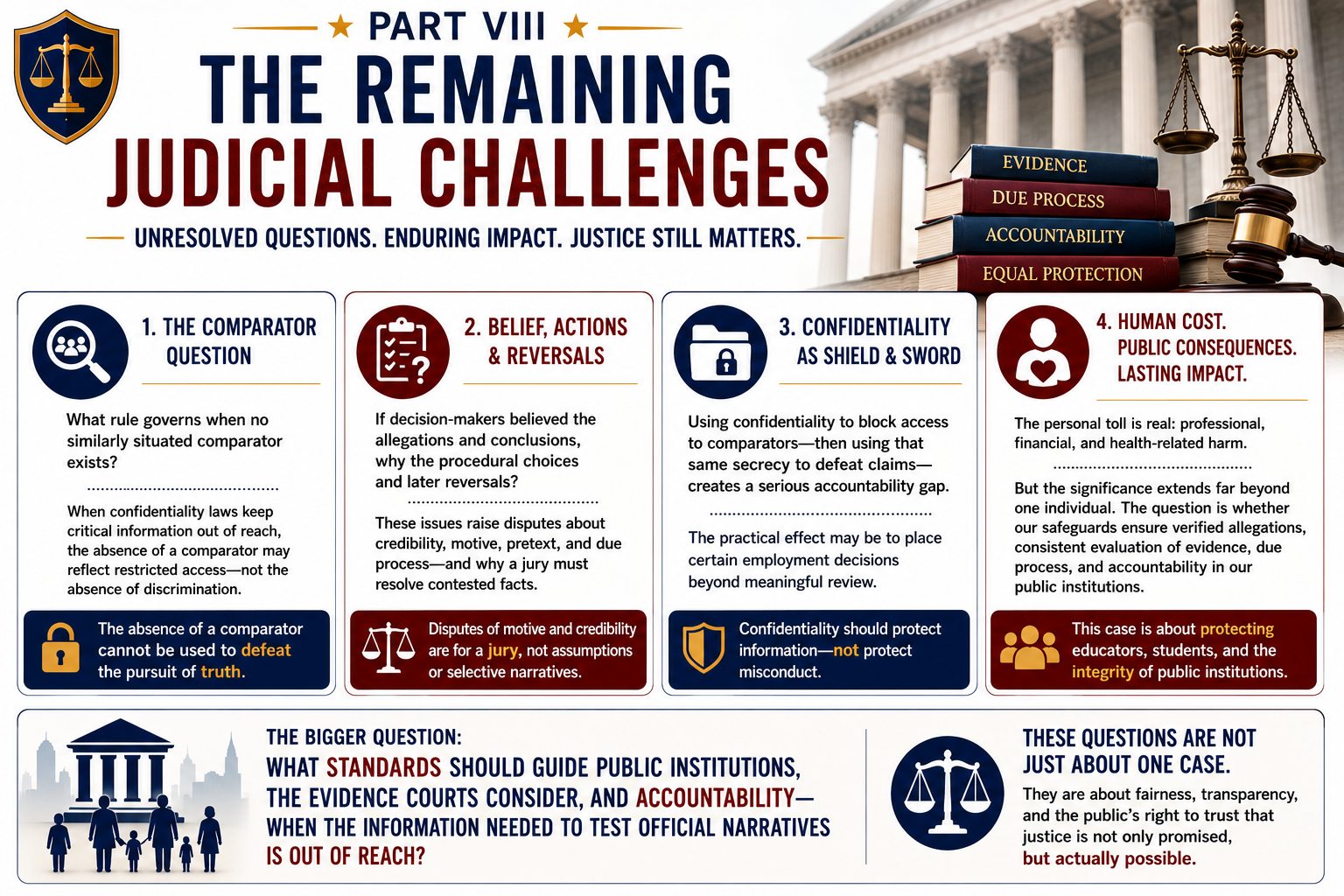
Although much of the factual record has now been assembled, several important judicial questions remain unresolved. At the center of this dispute is a fundamental question of employment discrimination law: What rule governs when no similarly situated comparator exists?
Related questions remain concerning the District’s asserted reliance on its own investigative findings. If decision-makers genuinely believed the allegations and conclusions they advanced, the record presents difficult questions regarding subsequent actions, procedural choices, and later reversals. These issues continue to generate disputes concerning credibility, motive, pretext, due process, and the proper role of a jury in resolving contested facts.
Beyond the legal questions lies a broader public concern. If confidentiality can be used to prevent access to information necessary to identify comparators while simultaneously being invoked to defeat discrimination claims, significant accountability concerns arise. The practical effect may be to place certain employment decisions beyond meaningful review.
The personal consequences of these events have been substantial, including professional, financial, and health-related impacts. Yet the significance of the case extends beyond a single individual. The remaining judicial challenges concern whether existing safeguards are sufficient to ensure that allegations are verified, evidence is evaluated consistently, due process is preserved, and public institutions remain accountable to the laws they are entrusted to enforce.
Ultimately, the unresolved questions are not merely about one teacher, one district, or one
dispute. They concern the standards by which public institutions are judged, the evidence
courts must consider, and whether accountability mechanisms remain effective when the
information necessary to test official narratives is unavailable. These questions continue
to warrant careful judicial examination.