
When Fairness Disappears
At Quintanilla Middle School STEAM Academy in Dallas, something didn’t just go wrong. Something shifted.
In the span of three years, a campus once celebrated for academic growth and staff stability became an outlier, statistically, culturally, and ethically. Trust collapsed, teachers fled, demographics flipped, and six unverified student statements out of approximately 657 students were transformed into allegations severe enough to justify branding a veteran educator as a danger to children.
This is not the story of one complaint. This is the continuing story of a recurring pattern of administrative practices.
Internal evidence revealed campus White and Hispanic staff declined while African American staff increased. Patterns don’t lie. Staffing data, grievance outcomes, and vanished records reveal documented practices and procedures where enforcement is selective and bias is normalized. This installment connects numbers to names and decisions, revealing how fear and favoritism quietly reshape institutions meant to serve children.
When the Numbers Stop Lying
Investigations often begin with documents. This one began with data.
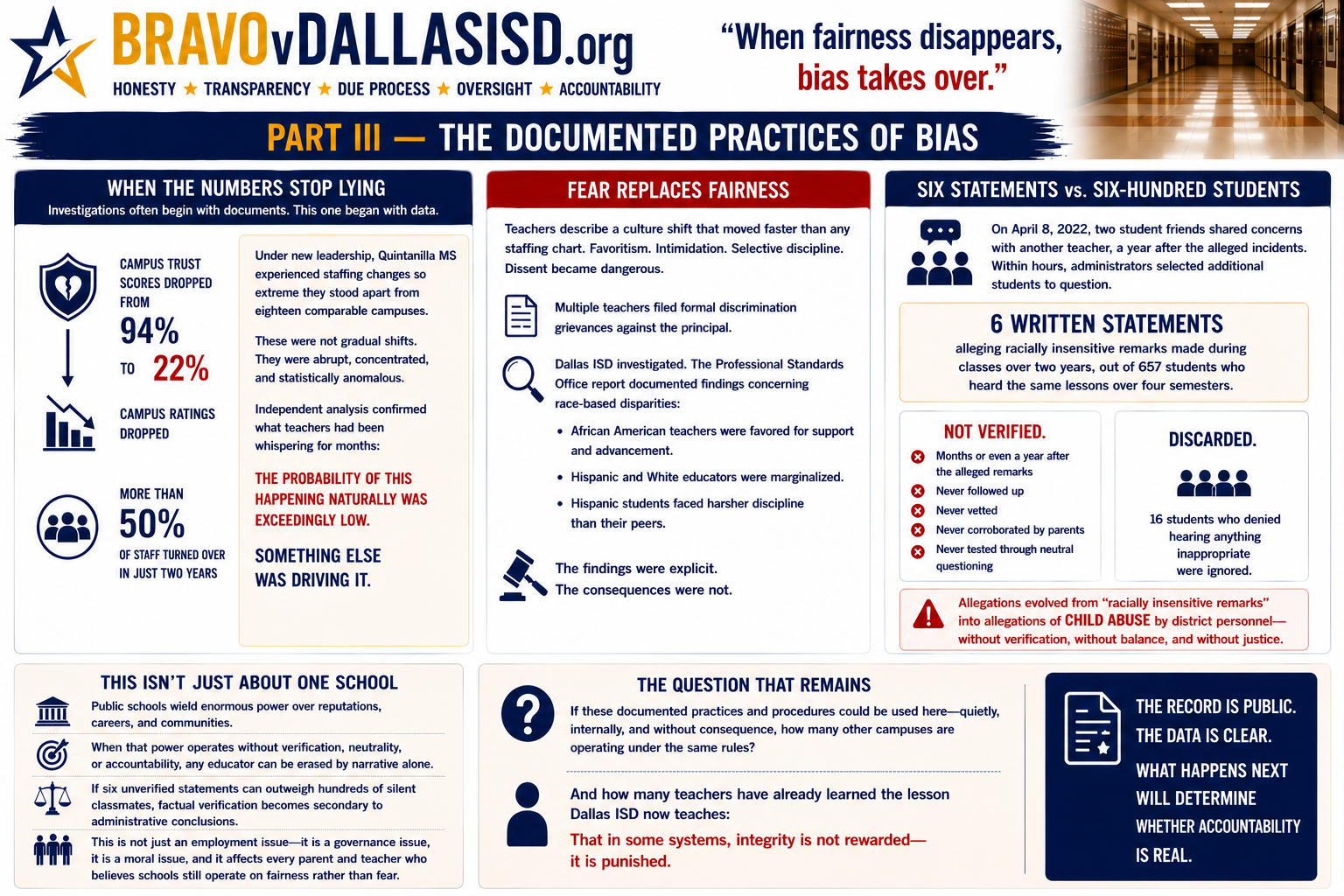
Under new leadership, Quintanilla MS experienced staffing changes so extreme they stood apart from eighteen comparable campuses in the district. These were not gradual shifts. They were abrupt, concentrated, and statistically anomalous. Independent analysis confirmed what teachers had been whispering for months: the probability of such a demographic reversal occurring naturally was exceedingly low. Something else was driving it.
Fear Replaces Fairness
Inside the building, teachers describe a culture shift that moved faster than any staffing chart. Campus trust scores collapsed from 94 percent to 22 percent. Campus ratings dropped. More than half the staff turned over in just two years. Educators reported favoritism, intimidation, and selective discipline. Dissent, they say, became dangerous. Then came the complaints.
Multiple teachers filed formal discrimination grievances against the principal. Dallas ISD investigated. The resulting Professional Standards Office report documented findings concerning race-based disparities in treatment and opportunities: African American teachers were favored for support and advancement, while Hispanic and White educators were marginalized. Hispanic students, the report noted, faced harsher discipline than their peers. The findings were explicit. The consequences were not.
The principal remained in place for a third year then was promoted to a high school principal position where White staff quickly declined by 40 percent, Hispanic staff increased 4 percent, and African American staff increased by 15 percent,.
Six Statements vs. Six-Hundred Students
On April 8, 2022, two student friends shared concerns with another teacher, a year after the alleged incidents. Within hours, administrators selected additional students to question. Six written statements emerged, alleging racially insensitive remarks made during classes over two years, out of 657 students who heard the same lessons over the four semesters.
Six statements, some sharing strikingly similar phrasing. Six statements, written months or even a year after the alleged remarks. Six statements that were never followed up, never vetted, never corroborated by parents, and never tested through neutral questioning. Six statements that were elevated by administrators into allegations of child abuse under the Educators’ Code of Ethics.
Meanwhile, the responses of sixteen students who denied hearing anything inappropriate were discarded. The investigation asked no questions that might uncover context, misunderstanding, or contradiction. It did not examine lesson plans. It did not interview parents. It did not attempt to determine whether the alleged remarks were misinterpreted discussions of poverty, scholarships, or demographics.
Instead, the allegations evolved from claims of racially insensitive remarks into allegations of child abuse by district personnel stretching from the campus to the Chief of Human Capital Management, expanded beyond what the students themselves wrote and used to justify the most serious professional charge an educator can face. The escalation was swift, the verification was nonexistent, and the imbalance was unmistakable.
This Isn’t Just About One School
Public schools wield enormous power over reputations, careers, and communities. When that power operates without verification, neutrality, or accountability, any educator can be erased by narrative alone.
This case exposes a deeper risk: that systems designed to protect students can be applied in ways that prioritize institutional interests over independent verification. That allegations can be elevated when they align with leadership interests and ignored when they do not. If six unverified statements can outweigh hundreds of silent classmates, factual verification becomes secondary to administrative conclusions, and when oversight fails to intervene, concerns remain unaddressed.
This is not just an employment issue, it is a governance issue, it is a moral issue, and it affects every parent and teacher who believes schools still operate on fairness rather than fear.
What Must Change
Investigative journalism is not only about exposure. It is about repair. Experts say restoring trust requires reforms that remove discretion where bias can hide:
-
Independent Oversight
All discrimination and serious misconduct investigations should be audited by independent reviewers when administrators are themselves the subject of complaints. -
Verification Before Escalation
Student statements used for discipline must be corroborated through follow-up interviews, parental notification, and neutral fact-finding before they can justify severe charges. -
Transparency in Data
Campus staffing and discipline data should remain publicly accessible. Sunlight is not optional in public institutions. -
Accountability With Consequences
Findings of systemic bias cannot end in reports alone. Without corrective action, investigations become theater.Systems do not correct themselves. They change when the cost of silence becomes higher than the cost of truth.
The Question That Remains
If these documented practices and procedures could be used here quietly, internally, and without consequence, how many other campuses are operating under the same rules? And how many teachers have already learned the lesson Dallas ISD now teaches: That in some systems, integrity is not rewarded, it is punished.
The record is public. The data is clear. What happens next will determine whether accountability is real.