
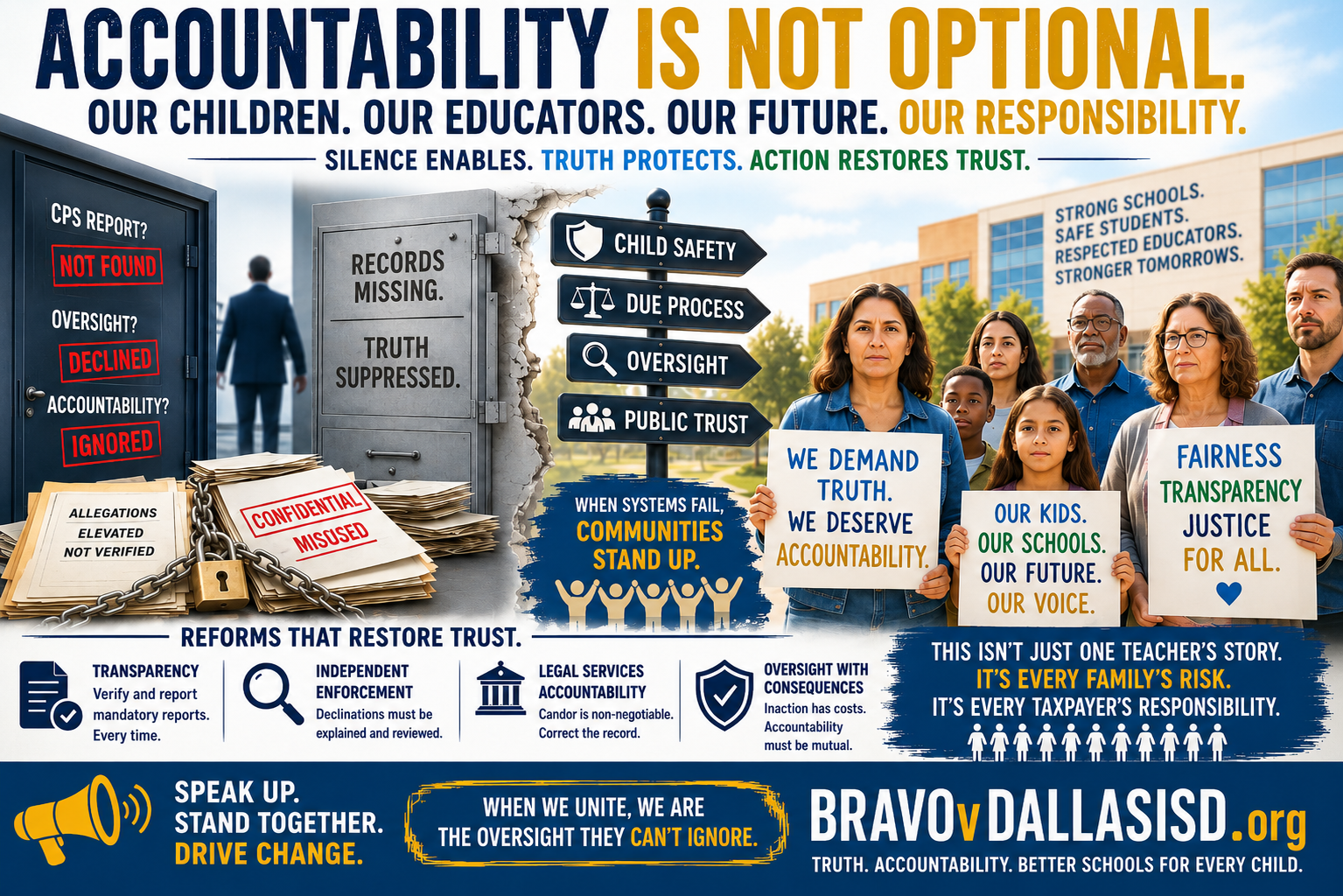
What happens when a system designed to protect children, teachers, and the public quietly
decides that accountability is optional? For four years, Dallas ISD officials insisted this
case was about student safety. But by the time the record reached its final chapters, the
question had shifted dramatically. Not whether allegations were made. Not whether
administrators said they believed them. But whether any external safeguard ever confirmed
them, and why once it became clear that none had, every institution charged with oversight
chose not to act.
At the center of this final report is a chilling revelation: when mandatory reporting laws, professional ethics rules, and state-level oversight mechanisms are tested simultaneously, silence can become policy. And silence, in public education, is not neutral.
If laws meant to protect children can be bypassed, if records can disappear, and if truth requires personal and financial ruin to surface, then no family or educator is safe. If left unchecked, Dallas ISD’s practices could become a statewide template for evading oversight while suppressing dissenting educators. Repeated citations to nonexistent statutorily compliant CPS reports and self-referential investigations by Legal Services suggest not oversight, but an entrenched culture of protection of existing administrative decisions and selective accountability. The integrity of Dallas ISD’s internal oversight, legal compliance, and public trust is at stake.
This story is not about one teacher, one campus, or even one district. It is about the structural risk created when allegations can be elevated to the most serious charge available, child abuse, without triggering the very system designed to verify and investigate such claims. Texas law requires educators and administrators to report suspected abuse directly to CPS. Oversight agencies exist precisely to ensure that obligation is enforced. Courts rely on the existence of those reports to evaluate whether institutions acted in good faith.
In this case, according to confirmed public records, no statutorily compliant CPS report ever existed, despite repeated references to one. When that fact was established, the expected response, investigation, correction, and discipline never came. Instead, the system closed ranks.
If a school district can:
-
invoke child safety without making a lawful report;
-
rely on confidentiality to block scrutiny;
-
avoid enforcement by the state agency tasked with oversight; and
-
preserve the narrative without consequence;
then every parent, educator, and taxpayer inherits the risk. Because a system that does not have to prove its claims does not have to be right.
Conflict, Tension, and Moral Stakes
This report exposes the most unsettling conflict of the entire record: the gap between authority and accountability. Once the absence of a lawful CPS report was confirmed, every subsequent decision became a moral test:
-
Would district leaders correct the record or protect themselves?
-
Would state regulators investigate or decline without explanation?
-
Would legal counsel prioritize candor or continued reliance on the original rationale?
The record shows a familiar pattern: when responsibility is diffused across institutions, no single actor claims ownership and misconduct survives by inertia. This is where the story turns from procedural to moral.
Child-safety laws exist to protect the vulnerable. Due-process protections exist to prevent abuse of power. Oversight exists to ensure neither is optional. When all three fail simultaneously, the danger is not abstract. It is systemic.
Inspiring Hope Without Softening the Truth
Investigative journalism does not exist to reassure, it exists to reveal. But this evidence also makes clear that systems can still be repaired if exposure leads to action. Public trust is not restored by press releases or settlements. It is restored when institutions prove through structure, not slogans that misconduct cannot hide behind silence.
The hope in this story lies not in its ending, but in its publication. Because once these failures are documented, denial is no longer plausible.
Recommendations to Restore Public Trust
Based on the failures identified in this report, investigative best practice points to concrete reforms, not aspirational language:
-
Mandatory Transparency for Mandatory Reporting – Require school districts to publicly certify that all allegations triggering mandatory reporting statutes resulted in verifiable CPS confirmations without compromising student safety or due process.
-
Independent Enforcement Triggers – When a state agency declines to investigate alleged statutory violations, the decision and rationale should be published and automatically referred to an independent oversight body, such as the Attorney General or Inspector General.
-
Legal Services Accountability – Public-sector attorneys must be required to correct the record when material factual assumptions collapse. Candor toward the tribunal must be enforced with the same seriousness as misconduct by educators.
-
Oversight With Consequences – Oversight agencies that repeatedly decline enforcement in the face of documented statutory violations must themselves be subject to legislative review.
Trust cannot survive where consequences do not exist.
Why Every Parent, Teacher, and Taxpayer Should Care
Everyone who has or knows a child in public school, or who is a teacher, was one, knows one, or aspires to be one, should care deeply about this cause. Today, both already face compounding stressors, social pressure, digital scrutiny, economic instability. The last thing they should fear is that administrative misconduct will harm them.
What happened here is not just about one teacher, it exposes dangerous handling allegations and investigations with the effect of elevating unverified student allegations, oversight inaction, and educators stripped of due process, all while children are denied the protections the law requires.
If Dallas ISD can bypass CPS reporting, misuse confidentiality as both shield and sword, and conceal evidence to discriminate with impunity, then no student, family, or teacher is safe from the same abuse of power. This fight is about protecting the integrity of our schools, ensuring children receive the care and protection they deserve, and making sure educators are treated with fairness and dignity.
That is why your voice matters. By speaking up to those in positions of power, school
boards, legislators, oversight agencies, and donors, you can help stop this conduct before
it spreads further. And because justice requires resources, your support in helping
educators overcome the overwhelming challenges is essential to ensure that truth is exposed,
accountability is enforced, and future generations of students and teachers are protected.
Individuals may be powerless, but groups are not. The strength of a community lies in its
unity, when educators, parents, and citizens join together, they become the oversight that
institutions fear most and democracy depends on. Let’s send a message that fiscal
responsibility to students and teachers comes before shielding administrators.