
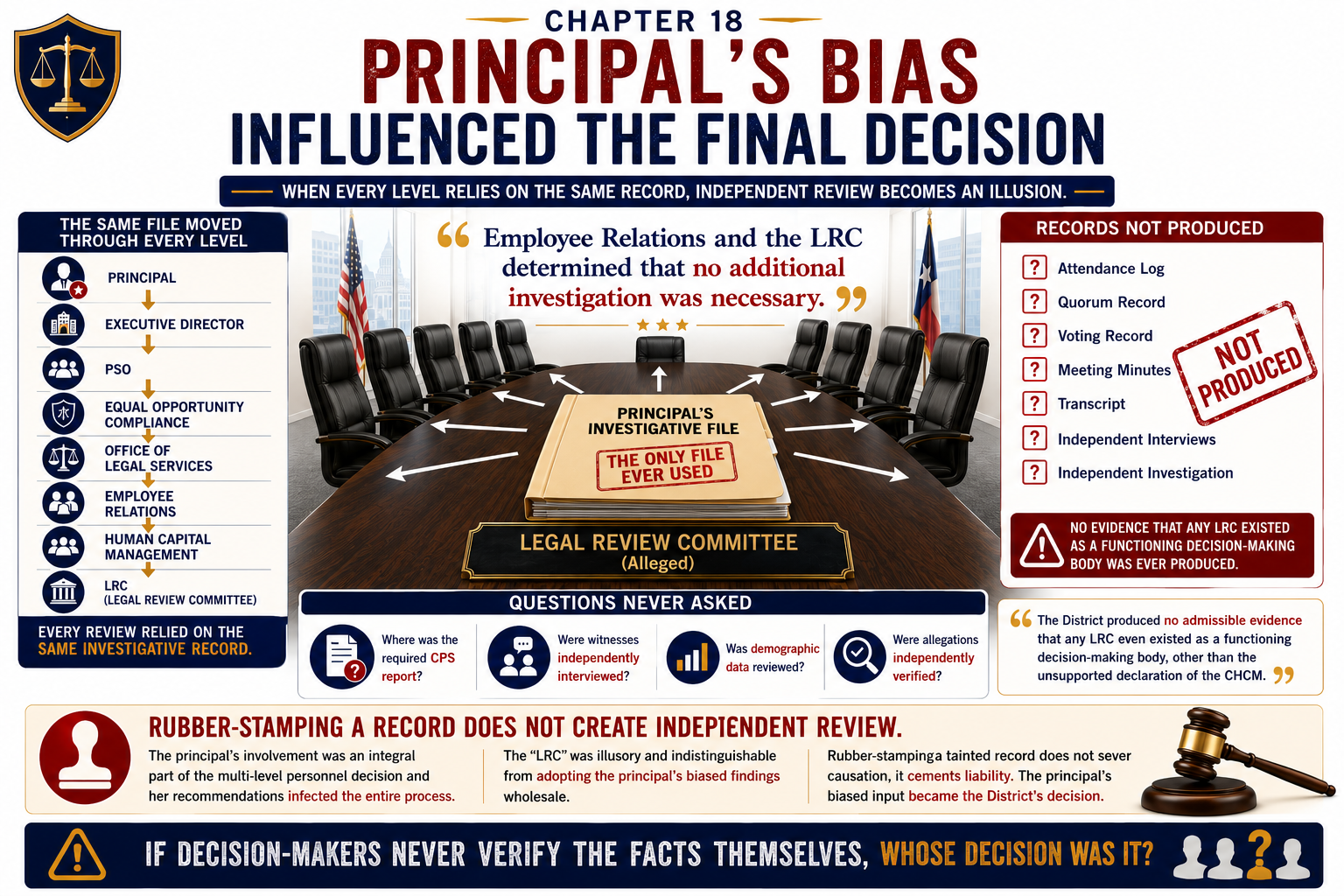
Records indicate the principal’s views and actions influenced all subsequent reviews and every higher-level review body rubber-stamped her biased record. Dallas ISD’s oversight of her conduct included: her Executive Director, the PSO, Equal Opportunity Compliance, Office of Legal Services, Employee Relations, Human Capital Management, and the LRC. All relied exclusively on the investigative file compiled by the principal despite her failure to comply with mandatory state reporting laws.
Furthermore, the District produced no admissible evidence that any LRC even existed as a functioning decision-making body, other than the unsupported declaration of the CHCM. No attendance log, quorum record, voting record, transcript, meeting minutes, or testimony from any additional purported committee member was ever produced.
In spite of four employees required to submit a statutorily compliant CPS report based on Texas Family Code and the District’s policy to overreport, committee members never inquired why the relied-upon report was missing, conducted any independent interviews, or fact-checked the student statements before the termination recommendation or final decision. Nor was any statistical demographic analysis completed after I filed a grievance against the principal.
In his declaration, the CHCM, could not recite specific statements made by him or others during the alleged LRC meeting, nor name the members or specify what documents each committee member reviewed. Because Dallas ISD did not produce any transcript of this meeting, he instead explained that the committee comprised of 7-10 senior level executives who did not independently investigate the allegations, besides looking through the legal review packet largely prepared by the principal, for about 10 minutes. Furthermore, the District’s record stated, “Employee Relations and the LRC determined that no additional investigation was necessary (DISD App. 15, 317).”
The principal’s involvement was an integral part of the multi-level personnel decision and
her recommendations infected the entire process. This final decision-making “LRC” was
illusory and indistinguishable from adopting the principal’s biased findings wholesale.
Under precedents, rubber-stamping a tainted record does not sever causation, it cements
liability. The principal’s biased input served as the foundation of the investigative record
and the LRC merely adopted her findings without any independent verification. This
rubber-stamping converts her discriminatory intent into the District’s intent, raising the
District legal and governance accountability concerns for her bias.