
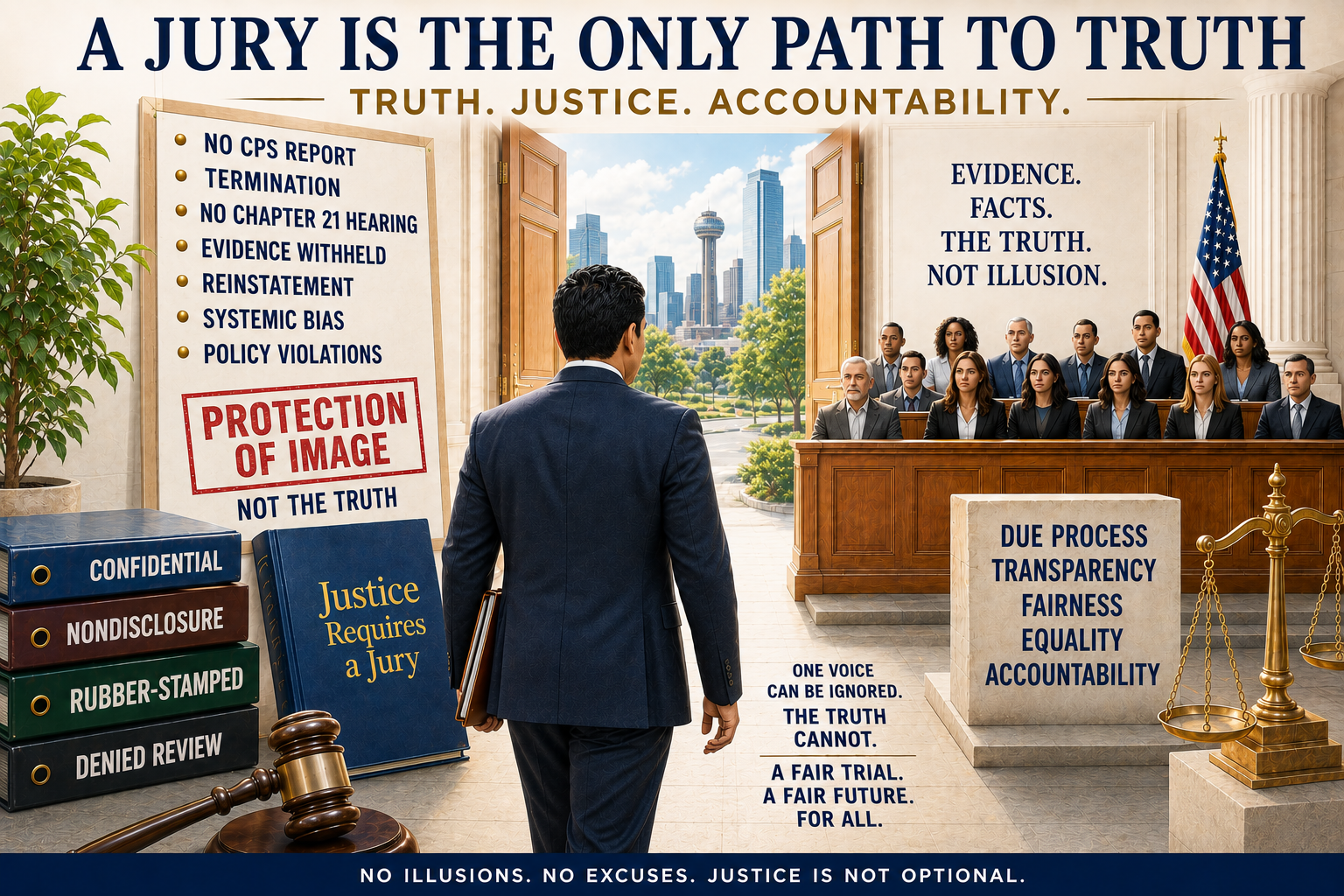
In public communications, Dallas ISD repeatedly relies on the familiar statement:
“The District cannot comment on pending litigation, but we ensure that all policies and
procedures are being followed and we are committed to the safety of all students.”
This assurance, while intended to project confidence and control, contrasts sharply with the
record in this case. The absence of any statutorily compliant CPS report, the nondisclosure
of evidence, and the eventual reinstatement without corrective measures demonstrate that the
District’s actions did not match its public rationale. The statement functions less as a
commitment to safety and more as a shield from accountability, an institutional reflex to
preserve image rather than confront systemic non-compliance.
Over the years, Dallas ISD’s leadership has drifted from a culture of responsibility toward
a culture of appearances, where the measure of success has become how well a problem is
managed publicly, not whether it is resolved truthfully. Campuses once designed to shape
virtue and uphold shared community standards are now reshaped by personal bias. When a
principal’s preference overrides principle, fairness dissolves, and the school ceases to
serve its moral and educational purpose. Too many administrators speak of innovation,
transformation, and equity, yet shy away from the plain demands of honesty, accountability,
and moral truth.
Dallas ISD did not merely mishandle a personnel dispute; it dismantled every safeguard
designed to ensure fairness. By bypassing CPS reporting, foregoing a Chapter 21 hearing, and
relying on confidentiality provisions that restricted transparency and access to relevant
information, the District significantly limited opportunities for independent verification,
external review, and procedural accountability.
District Legal Services reviewed, approved, or defended evidence of the principal’s conduct,
comparator investigations, demographic analysis, sworn affidavits, the missing CPS report,
rubber-stamping the tainted file, denying a Chapter 21 hearing, and institutionalized the
District’s systemic bias.
Title VII asks one question: did the employer intentionally discriminate? I believe ample
evidence has been provided for a jury to decide.
As a final argument, no matter how many justifications the District produces to try to prove
they believed the student statements, the facts that (1) the first four believers failed to
submit statutorily compliant CPS reports; (2) all believers who were also decision-makers
failed to demand it be produced for their review; (3) five decision-makers made scathing
declarations against the teacher’s fitness to teach; and (4) the teachers reinstatement with
no reprimands, disciplinary action, or corrective action required; raises serious questions
regarding whether Dallas ISD’s actions were consistent with nondiscrimination policies and
statutes.
The District’s arguments are built not on compliance but on illusion, and Title VII and due
process require that truth be exposed. To accept the District’s rationale would allow
discrimination to hide behind technicalities and evade reality.
Still, I remain optimistic that the six students who alleged I made improper statements may
learn important lessons from this experience. I do not blame them. In middle school, their
critical thinking skills were not yet fully developed. That fact must be considered when
they make mistakes. My hope is that, in time, they come to understand that the greater
lesson was never about a few words in a classroom, but about how easily perception can
become distortion when repeated without question. In the divided world they are about to
enter as adults, learning to recognize truth from noise will serve them well.
In the end, this story grew beyond one teacher, one principal, or even one district. It is
about ensuring that public education systems uphold honesty, transparency, compliance, due
process, oversight, and accountability for students and educators. Whether truth will be
silenced by bias and convenience, whether discrimination can be shielded by illusion, and
whether the lessons of justice and due process will be denied, will be dependent on open
dialogue and public oversight.
And beyond the statutes and procedures lies something deeper. Teachers, mentors, and role
models spend years immersed in shaping lessons, wrestling with ideas, refining words, and
hoping that time together might change a student’s understanding of themselves, others, or
the world. They wonder: will the lessons challenge their assumptions, influence their
choices, or even alter the trajectory of their lives? That was always my purpose, not only
to improve myself, but to help others improve even more.
I pray each day that enough caring individuals will recognize the truth of what is happening and choose to stand with teachers in this long and painful fight. The weight of having to endure this battle alone is heavy, and the fear of being left without support lingers in my heart. Yet, I continue to hold on to hope that people of conscience will not allow silence or indifference to prevail. What I have endured is not simply a personal injustice; it represents a broader danger that threatens every teacher who strives to do right by their students, and every student whose safety depends on adults following the law with integrity. And true District leadership is measured not by control but by candor, not by reputation management but by the courage to confront wrongdoing.
In Dallas ISD, complaints are too often met with defensiveness, scrutiny is treated as
betrayal, and protection of image eclipses pursuit of truth. Leadership that hides from
accountability disqualifies itself from trust. If these documented practices and
procedures enabling discrimination and nondisclosure is left unchallenged, it will continue
to harm others with the same impunity that has already shattered my life and career. My plea
is not only for myself, but for the greater cause of protecting fairness, truth, and dignity
in our schools. I ask that compassionate voices rise beside mine and contribute to this
cause so that no teacher, no student, and no family ever has to face such injustice in
isolation again.