
How a School District Cited Child-Abuse Law Without Ever Following It
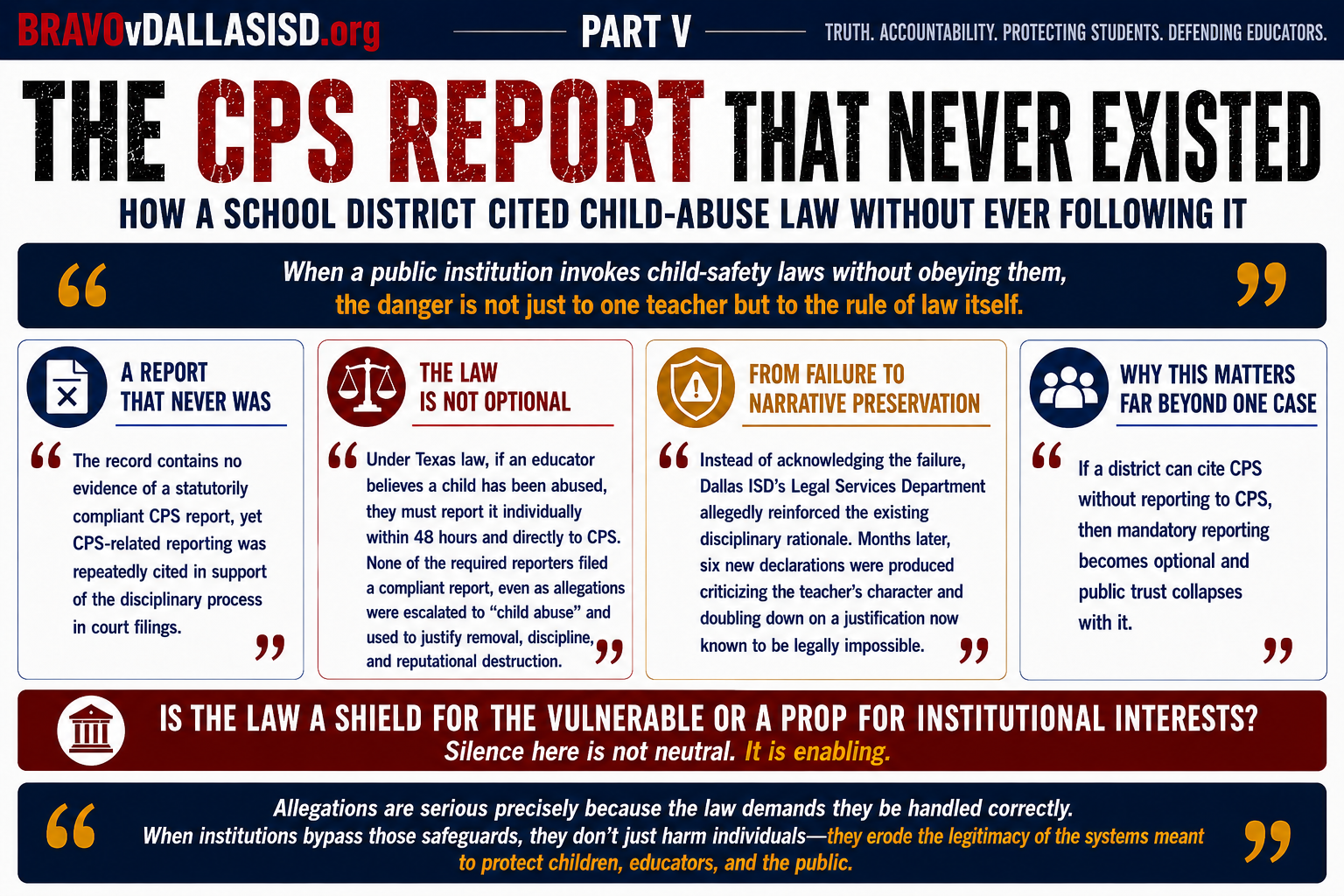
When a public institution invokes child-safety laws without obeying them, the danger is not just to one teacher but to the rule of law itself. This part reveals a quiet but devastating truth: Dallas ISD repeatedly justified extreme disciplinary actions by invoking Child Protective Services yet never produced a single statutorily compliant CPS report. What follows is not a paperwork error, but a portrait of how procedure can be bent into power, and how silence can replace accountability when no one forces the truth into the light.
The record contains no evidence of a statutorily compliant CPS report, yet CPS-related reporting was repeatedly cited in support of the disciplinary process in court filings. Then in spite of this evidence, Dallas ISD’s Legal Services Department obtained five new administrator declarations criticizing my character. The sequence suggests continued reliance on the original disciplinary rationale despite emerging contradictory evidence, raising serious ethical and statutory concerns.
These procedural violations were neither accidental nor isolated. Each procedural irregularity in this case passed through Legal Services, the department tasked with ensuring both lawful conduct and fidelity to truth. They reviewed, approved, and defended them. Once the absence of a lawful CPS report was confirmed, any genuine “belief” in the child-safety rationale should have ended. By reinforcing a discredited record instead of correcting it, Dallas ISD’s counsel raises questions regarding whether the record was fully reassessed after contradictory information emerged, transforming a due-process violation into a potential breach of professional-conduct duties owed to the public. This chapter builds tension around a missing document that collapses the district’s stated justification and raises concerns regarding systemic governance failures involving transparency, compliance, oversight and accountability.
A Law That Was Never Used But Constantly Cited
For more than two years, Dallas ISD defended its actions with a single, powerful claim: child safety required it.
Court filings referenced CPS dozens of times. Administrators testified under oath about their “belief” that mandatory reporting laws had been triggered. The implication was unmistakable, this was about protecting children, not punishing a teacher. But there was a problem. When state authorities were finally asked to produce the CPS report that supposedly justified everything, they couldn’t because it never existed. No report containing student names. No guardian names or contact information. No factual information reflecting their belief submitted to Child Protective Services.
Under Texas law, that means no report at all. Thus, the DFPS response raises questions regarding the factual basis for the district's continued reliance on CPS-related representations.
The Law Is Not Optional
Texas Family Code Chapter 261 is blunt by design. If an educator believes a child has been abused, they must report it individually within 48 hours and directly to CPS. They cannot delegate that duty. They cannot rely on internal investigations. And they cannot selectively invoke the law after the fact.
Yet according to DFPS confirmation and court records, none of the required reporters filed a compliant report, even as allegations were elevated to “child abuse” and used to justify removal, discipline, and reputational destruction. This contradiction raises a disturbing question: If administrators truly believed students were in danger, why didn’t they follow the one law designed to protect them?
From Failure to Narrative Preservation
The story doesn’t end with the missing report. It deepens. Once the absence of a lawful CPS report was confirmed, the district faced a choice: reevaluate the record or continue relying on the existing rationale. Instead of acknowledging the failure, Dallas ISD’s Legal Services Department allegedly reinforced the existing disciplinary rationale. Months later, six new declarations were produced by Dallas ISD counsel criticizing the teacher’s character, reiterating beliefs, and doubling down on a justification now known to be legally impossible.
This was no longer about a missed step. It was about maintaining the appearance of compliance after the facts had disproven it. For public lawyers, whose client is not an administrator but the public itself, this is where the story turns from procedural failure to ethical crisis.
Why This Matters Far Beyond One Case
This investigation exposes a dangerous precedent with statewide implications:
-
Child-safety laws were invoked without being followed, undermining their credibility and purpose.
-
Due process was denied, because without a CPS report there was no neutral investigation, no parental notification, and no external oversight.
-
Oversight systems failed, as neither district leadership nor the state agency tasked with enforcement intervened even after being notified.
-
Legal accountability was blurred when government attorneys defended an administrative conclusions unsupported by law or fact.
If a district can cite CPS without reporting to CPS, then mandatory reporting becomes optional and public trust collapses with it. This is not about choosing sides in a dispute. It is about whether laws meant to protect children can be selectively ignored by the very institutions sworn to uphold them.
The Moral Center
At its heart, this report confronts a simple moral question: Is the law a shield for the vulnerable or a prop for institutional interests?
Child-abuse statutes exist to ensure that allegations are handled with urgency, neutrality, and professional care. When those statutes are bypassed, students lose protection, educators lose rights, and the public loses confidence that truth not convenience guides decision-making. Silence here is not neutral. It is enabling.
Leads for Continued Investigation
An investigative newsroom or oversight body could immediately pursue:
-
A full audit of Dallas ISD CPS reporting practices over the past five years, comparing internal allegations to verified DFPS reports.
-
A timeline analysis of when district counsel learned no CPS report existed and what actions followed.
-
A review of sworn declarations submitted after discovery of the missing report, assessing coordination, authorship, and ethical compliance.
-
State-level enforcement records, examining why Texas Family Code §261.109 penalties were never investigated against the three required to report despite notice.
Recommendations to Restore Legal Compliance
This case points clearly toward reform not punishment for its own sake, but guardrails that prevent repetition:
-
Mandatory CPS Verification
Require school districts to produce DFPS confirmation numbers for every alleged child-abuse report relied upon in discipline or litigation.
-
Automatic Referral for Non-Reporting
Any instance where abuse is alleged internally but not reported externally should trigger review by the Texas Attorney General under §261.109.
-
Transparency Through Reporting
Publish quarterly CPS-compliance reports showing when reports were filed, verified, or rejected without student identifiers.
-
Legal Services Accountability
Clarify that district attorneys represent the public interest, with an affirmative duty to correct the record when statutory justifications fail.
This investigation does not argue that allegations should be ignored. It argues the opposite. Allegations are serious precisely because the law demands they be handled correctly.
When institutions bypass those safeguards, they don’t just harm individuals, they erode the legitimacy of the systems meant to protect children, educators, and the public itself. And once that trust is gone, no rationale however forcefully repeated can replace the truth.