
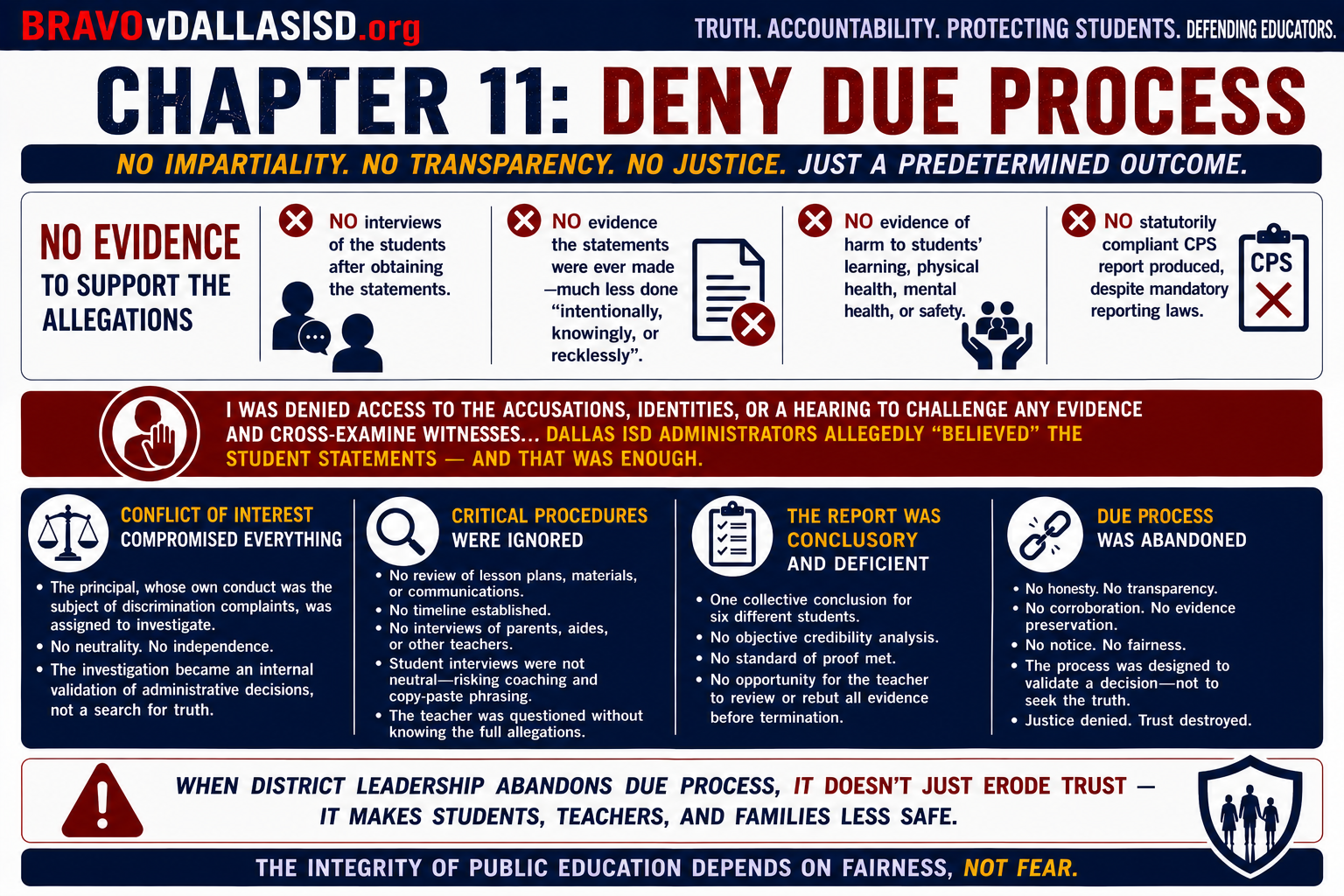
When the principal was assigned to investigate the allegations, that investigation included reading the six statements and asking me a few questions without revealing their purpose or any evidence collected thus far. No one ever interviewed the students after obtaining the statements. No one other than the students and Dallas ISD knew what was written. No impartial investigator ever vetted the allegations. No evidence that the statements were ever made, much less done “intentionally, knowingly, or recklessly”. No evidence that the six students’ learning, physical health, or mental health were adversely affected. No evidence that their safety was endangered.
I was denied access to the accusations, identities, or a hearing to challenge any evidence and cross-examine witnesses. But none of this mattered to the Dallas ISD administrators because they allegedly “believed” the student statements and that was enough to warrant their conduct.
Evidence indicates the District’s investigation into the six student accusations against the teacher was procedurally deficient and failed to meet even the minimum standards of impartiality, due process, and statutory compliance required under Title VII, the Texas Education Code, and the Texas Family Code. From the outset, evidence shows the principal neglected to produce any statutorily compliant CPS report, despite allegations that, if child abuse were believed, it would have triggered mandatory child-safety notifications under §261.101, §261.102, §261.104, and penalties under §261.109 . This omission alone raises doubts over the district genuinely believing the allegations, as no immediate action was taken to protect students or to comply with state law.
Evidence indicates the principal operated under an inherent conflict of interest, the individual whose own conduct had been the subject of discrimination complaints. No neutrality and the assignment itself violated the principle of independence central to both EEOC and TEA investigatory standards. This conflict tainted every step of the process, allowing the investigation to function more as an internal validation of administrative decisions than as a search for truth.
Critical evidentiary procedures were ignored. As the investigator, she failed to gather or review lesson plans, classroom materials, or communications logs that would have contextualized the alleged comments. No timeline was established, and no secondary witnesses such as parents, aides, or other teachers were interviewed. The six student interviews were not neutral, increasing the risk of cross-contamination, copy-paste phrasing and coaching bias. The teacher was questioned without being informed of the full allegations, violating both fairness and due-process standards.
The report that resulted from this process was conclusory, collective, and devoid of analytical rigor. It offered a single determination rather than evaluating each student’s claim individually. It failed to meet any reasonable standard of proof. It made credibility judgments without any objective framework. There was no opportunity for the teacher to review or rebut all the evidence prior to termination. Collectively, these failures demonstrate that the district’s investigation was not impartial, but functioned primarily to validate an existing disciplinary conclusion rather than test competing explanations. The absence of basic investigative safeguards, honesty, transparency, neutrality, corroboration, evidence preservation, and notice renders the entire process procedurally invalid and indicative of pretext rather than good faith. Every safeguard meant to ensure fairness was stripped away and justice denied. When district leadership abandons due process, it doesn’t just erode trust, it makes students, teachers, and families less safe. The integrity of public education depends on fairness, not fear