
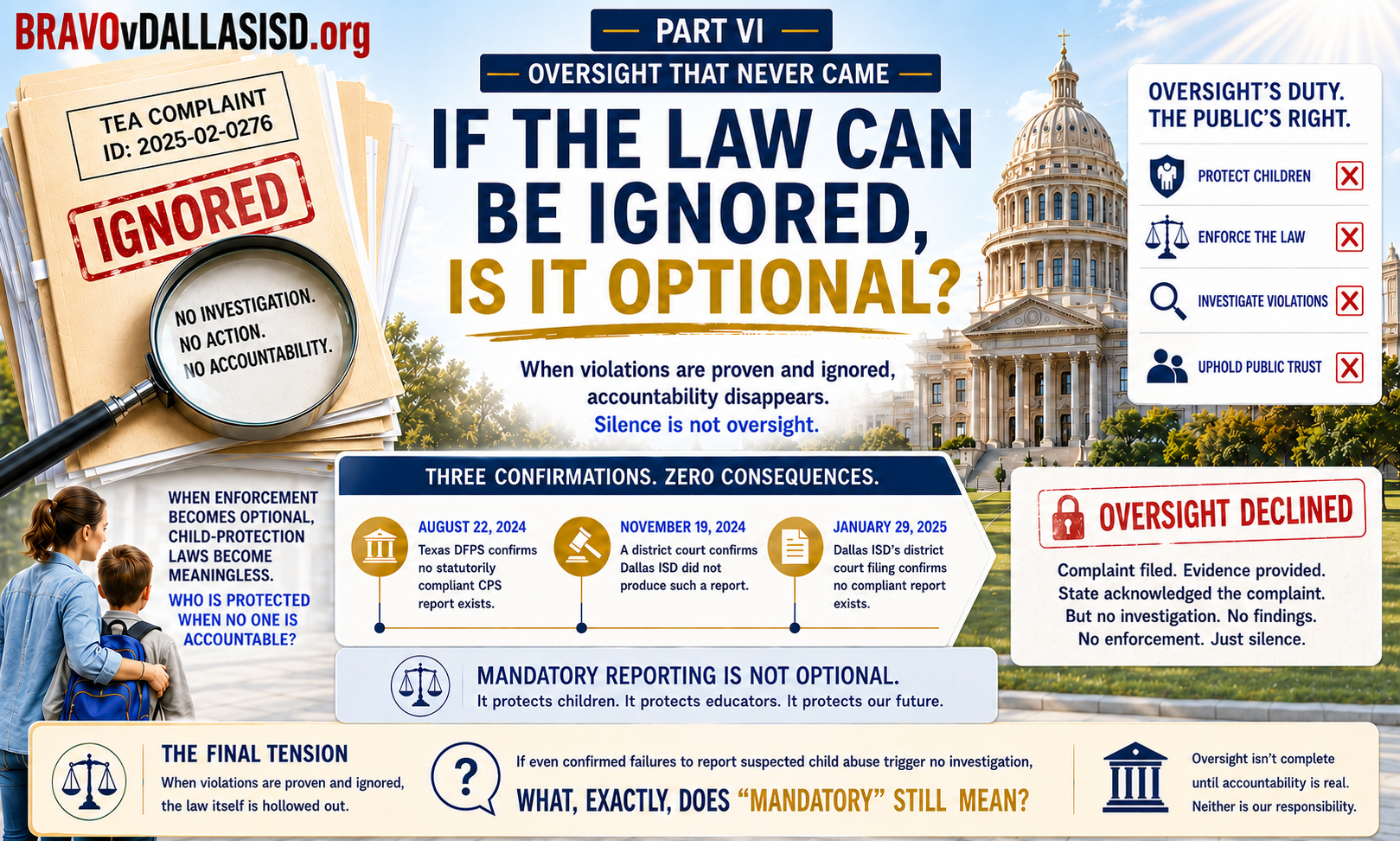
If The Law Can Be Ignored, Is It Optional
This is not just a story about a missing report. It is also a story about what happens when nobody is required to act after the absence is proven. District and TEA officials never investigated TEA Complaint ID:2025-02-0276. When violations were brought to state authorities, nothing happened. This report exposes how inaction by oversight agencies can be just as damaging as misconduct itself, allowing unlawful practices to persist unchecked.
By August 2024, a central fact was no longer in dispute: Dallas ISD had never produced a statutorily compliant Child Protective Services report despite repeatedly invoking one to justify accusations of child abuse against a teacher. The Texas Department of Family and Protective Services confirmed it. Courts acknowledged it. And then nothing happened. No internal discipline. No referral for investigation. No enforcement by the state agency charged with oversight.
This evidence examines how institutional inaction, both at the district level and within the Texas Education Agency, may have transformed mandatory child-safety laws into optional paperwork and how silence itself became the final decision.
Three Confirmations, Zero Consequences
The timeline is stark.
-
August 22, 2024 – Texas DFPS confirms that no statutorily compliant CPS report exists.
-
November 19, 2024 – A district court confirms Dallas ISD did not produce such a report.
-
January 29, 2025 – Dallas ISD’s district court filing confirms no compliant report exists.
Under Texas law, this sequence should have triggered immediate scrutiny. Mandatory reporting statutes are not discretionary. Failure to report suspected abuse is a criminal offense. Yet no administrator was investigated for noncompliance. No corrective action followed. Instead, when the matter was formally placed before state oversight, the response was silence.
Reassert the Narrative, Ignore the Law
After the absence of a lawful CPS report was established, a complaint was filed with the state in February 2025 seeking investigation into the reporting failures. At the urging of a state investigator, the complaint was forwarded directly to Dallas ISD leadership, the superintendent, police, and trustees with an invitation to address the violations internally. What followed was not an explanation of why mandatory reporting failed. It was a repetition of the same assertion already disproven: that an internal reference number constituted a CPS report despite DFPS having confirmed that the identifier did not exist in its system and did not meet statutory requirements. In effect, the district doubled down on a legal fiction.
The question this raises is not merely whether Dallas ISD misunderstood the law, but whether it chose continued reliance on the original rationale over correction, even after being confronted with conclusive evidence.
Oversight Declined
If district self-interest explains inaction locally, the state response raises a deeper concern. In July 2025, the assigned investigator informed the complainant that the Texas Education Agency would not open an investigation. No findings were issued. No explanation was publicly released. No enforcement action was taken.
A request for reconsideration followed. Then, in December 2025, a formal demand for agency action was made under established principles of Texas administrative law. Still, no investigation.
For parents and educators, this moment matters. Oversight does not fail only when agencies act improperly, it also fails when they refuse to act at all, even when statutory violations are facially established.
When Enforcement Becomes Optional
Mandatory reporting laws exist for a reason. They are designed to remove discretion when children’s safety is implicated. They ensure that allegations, true or false, are evaluated by trained professionals, not filtered through institutional self-interest.
When a district can invoke child safety to justify career-ending actions without actually reporting to CPS, and when the state declines to investigate that failure, the system sends a dangerous message: Child-protection laws apply unless enforcing them would expose institutional wrongdoing. That precedent does not just affect one teacher or one district. It signals to every educator, parent, and administrator in Texas that accountability may depend less on law than on silence.
Who Is Protected When No One Is Accountable?
This case forces a moral reckoning. If administrators genuinely believed students were endangered, why was CPS never properly notified? If the state believes mandatory reporting is essential, why was noncompliance not investigated once confirmed? And if oversight agencies decline to act even after multiple confirmations of statutory failure, who, exactly, is being protected? Because it is not children. It is not educators. And it is not the public trust. What remains protected is the system itself.
Recommendations to Restore Oversight and Credibility
Investigative reporting does more than expose failures, it illuminates paths forward. Based on the documented record, experts suggest three immediate reforms:
-
Automatic Escalation for Non-Reporting Allegations
Any TEA complaint alleging failure to comply with Texas Family Code §261 should trigger mandatory referral to an independent enforcement unit or the Attorney General, without discretionary screening. -
Public Disclosure of Closed Complaints
TEA should publish anonymized summaries of complaints closed without investigation, including the rationale. Oversight cannot exist in secrecy. -
Independent CPS-Compliance Audits
School districts should be required to undergo periodic audits verifying that all alleged child-abuse matters resulted in statutorily compliant CPS reports, with findings reported to the public.
Without these safeguards, mandatory reporting becomes aspirational rather than enforceable and oversight becomes symbolic rather than real.
The Final Tension
This story is not about hindsight. It is about what the public record already shows and what institutions chose not to do in response. When violations are proven and ignored, concerns remain unaddressed, accountability disappears. And when accountability disappears, the law itself is hollowed out.
The unanswered question now belongs to the public: If even confirmed failures to report
suspected child abuse trigger no investigation, what, exactly, does “mandatory” still
mean?