
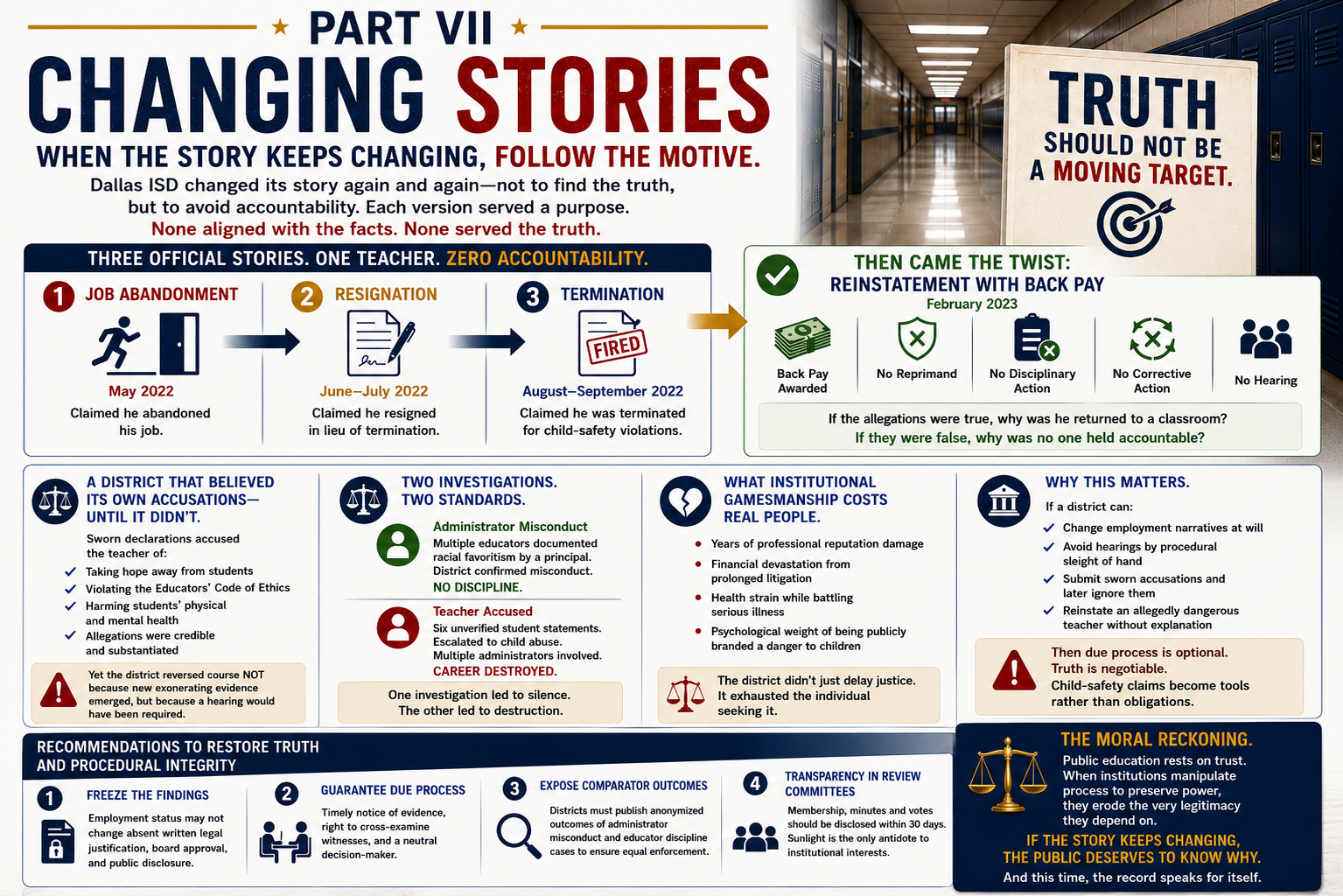
When the Story Keeps Changing, Follow the Motive
When institutions cannot defend their actions with evidence, they change the story. This report reveals how Dallas ISD repeatedly altered its official administrative conclusions, job abandonment, resignation, termination, and finally reinstatement with back pay, not to clarify the truth, but to obstruct oversight, block appeals, and avoid accountability. Each version served a procedural purpose. None aligned with the facts. None served the truth.
Dallas ISD shifted between “job abandonment,” “resignation,” and “termination” then reinstated Bravo with back pay, but no reprimands, disciplinary action, or corrective action required. Each label served a purpose, none served the truth. This section forces readers to grapple with an institution willing to contradict itself to avoid accountability.
Three Official Stories, One Teacher, Zero Accountability
Between May and September 2022, Dallas ISD described the same educator’s separation from employment in three mutually exclusive ways:
-
He abandoned his job.
-
He resigned in lieu of termination.
-
He was terminated for child-safety violations.
Each claim foreclosed a different legal right. Each avoided scrutiny. And each was later declared invalid by the Texas Education Commissioner for failure to comply with state law. Then came the twist. In February 2023, after months of sworn declarations accusing the teacher of racially abusive, child-endangering conduct, the district quietly reinstated him with back pay, no reprimand, no discipline, no corrective action, and no hearing.
If the allegations were true, why was he allowed back into a classroom and given access to more students? If they were false, why was no one held accountable for making them? That unanswered question is the heart of this investigation.
A District That Believed Its Own Accusations Until It Didn’t
Dallas ISD officials submitted sworn declarations asserting that:
-
The teacher “took hope away from students.”
-
His conduct violated the Educators’ Code of Ethics.
-
His classroom statements harmed students’ physical and mental health.
-
The allegations were credible and substantiated.
These were not casual claims. They were sworn statements submitted in litigation. Yet despite these assertions, the district reversed course, not because new exonerating evidence emerged, not because witnesses were cross-examined, and not because an independent body cleared the teacher, but because continuing the termination process would have required something the district had avoided from the beginning: A hearing. Evidence. Cross-examination.
Instead of testing its own allegations, Dallas ISD chose reinstatement as a “good business decision”, while still insisting it “believed” the accusations. This is the contradiction that demands public scrutiny: A district cannot simultaneously claim a teacher is a danger to children and knowingly place him back in a classroom with access to more students.
Two Investigations, Two Standards
This report also exposes a stark double standard.
-
When multiple educators filed formal complaints documenting racial favoritism by a principal, the district’s Professional Standards Office confirmed the misconduct but imposed no discipline.
-
When a single teacher was accused by six unvetted student statements, the district escalated the matter to child abuse and marshaled multiple administrators to reinforce the disciplinary rationale.
The contrast is not subtle. One investigation led to silence. The other led to destruction. This asymmetry raises a disturbing question: Was the process designed to find the truth or to protect those already in power?
What Institutional Gamesmanship Costs Real People
Behind the procedural maneuvers is a human cost rarely reflected in court filings:
-
years of professional reputation damage;
-
financial devastation from prolonged litigation;
-
health strain on a teacher already battling serious illness; and
-
the psychological weight of being publicly branded a danger to children without ever confronting accusers.
The record shows that the district’s shifting conclusions did not merely delay justice. They exhausted the individual seeking it. This is how systems silence dissent, not with one decisive act, but with attrition.
Why This Matters
This is not just a personnel dispute. If a public school district can:
-
change employment narratives at will;
-
avoid hearings by procedural sleight of hand;
-
submit sworn accusations and later ignore them; and
-
reinstate an allegedly dangerous teacher without explanation, then due process is optional, truth is negotiable, and child-safety claims become tools rather than obligations.
Every parent should care. Every educator should be alarmed. Every taxpayer should ask what else is being obscured. Because if accountability depends on persistence, money, and survival, then justice is no longer equal.
Recommendations to Restore Truth and Procedural Integrity
Based on these findings, investigative best practices support the following reforms:
-
Freeze the Findings – Once a district issues a disciplinary notice, employment status may not change absent written legal justification, board-level approval, and public record disclosure.
-
Guarantee Due Process – All educators facing serious allegations must be afforded timely notice of evidence, the right to cross-examine witnesses, and a neutral decision-maker.
-
Expose Comparator Outcomes – Districts must publish anonymized outcomes of administrator misconduct investigations and educator discipline cases to ensure equal enforcement.
-
Transparency in Review Committees – Legal Review Committee membership, minutes and votes should be disclosed within 30 days as sunlight is the only antidote to institutional interests.
The Moral Reckoning
Public education rests on trust. When institutions manipulate process to preserve power, they erode the very legitimacy they depend on. The question raised by this report is not whether one teacher deserved better, it is whether the system can be trusted to tell the truth at all. If the story keeps changing, the public deserves to know why. And this time, the record speaks for itself.