
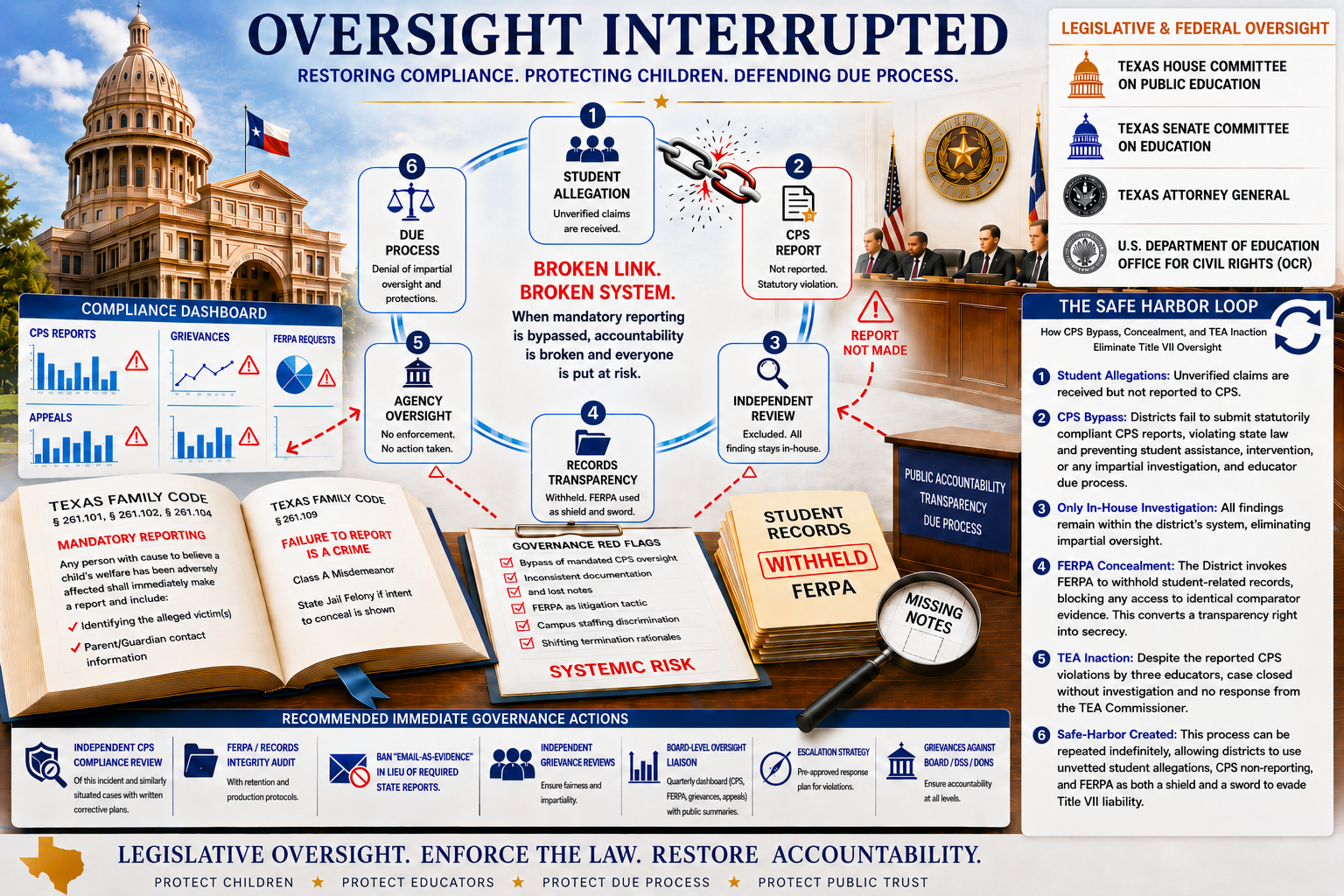
This case implicates multiple governance failures: CPS non-reporting, FERPA misuse, TEA
inaction, and Title VII violations.
When oversight collapses, misconduct does not merely persist, it metastasizes. This evidence reveals how Dallas ISD’s governance ecosystem, trustees, senior administrators, legal counsel and external oversight bodies failed at the precise moment accountability was required most. What emerges is not a single bad decision, but a systemic breakdown in institutional courage, where financial interests, reputational risk, and political convenience outweighed child-safety law, educator due process, and the public trust.
This is the story of what happens after wrongdoing is documented, when the real test is not discovery but response.
The Moment the System Was Put on Notice
By August 2024, the record was no longer ambiguous. Texas DFPS confirmed that no statutorily compliant CPS report existed, despite years of Dallas ISD representations that such a report justified drastic employment actions. Afterwards, courts were informed, trustees were informed, senior administrators were informed, and state regulators were informed. And yet nothing changed. No internal discipline. No independent investigation. No public correction. No referral for enforcement. No pause in litigation strategy. No governance reckoning. Instead, the institution closed ranks.
For investigative reporters, this is the inflection point that matters most: not whether misconduct occurred, but whether power chose accountability once it could no longer claim ignorance.
The Price of Looking Away
The documents show that once exposure became unavoidable, Dallas ISD did not pivot toward transparency. Instead, the district doubled down, producing post-hoc declarations, maintaining contradictory narratives, and relying on oversight silence as insulation. This created a perverse moral inversion:
-
A district that claimed child safety as justification, never complied with child-safety law.
-
A district that labeled conduct “child abuse”, reinstated the accused teacher without conditions.
Is the district entrusted with $6.2 billion in new bonds avoiding public disclosure of governance risk? Have donors, corporate partners, and civic institutions whose names lend legitimacy and financial stability ever been informed that the district faced unresolved statutory violations, discrimination findings, and potential criminal non-reporting exposure? The tension is unavoidable: Was silence strategic or was it complicity?
This Is Bigger Than One Case
This story is not about a single teacher, campus, or lawsuit. It is about whether public education governance in Texas can be trusted to self-correct when exposed to inconvenient truths.
If a school district can:
-
cite non-existent CPS reports;
-
avoid mandatory reporting laws without consequence;
-
reframe employment status to evade hearings;
-
ignore confirmed statutory violations; and
-
proceed with massive public financing;
then every safeguard parents and taxpayers rely upon becomes conditional, discretionary, and fragile.
What failed here was not policy. What failed was governance integrity. And when governance fails, the most vulnerable students, educators, and families without political leverage absorb the cost.
The Line Between Administration and Stewardship
Public education leaders are not merely managers of systems; they are stewards of trust. The moral failure documented with this evidence is not that mistakes were made, it is that once those mistakes were proven, leaders chose institutional interests over ethical repair.
Oversight bodies exist precisely for moments like this. When they decline to act, they send a devastating message: that compliance is optional for the powerful, and accountability is reserved for the expendable. That is not governance. That is abdication.
Recommendations to Restore Governance Integrity
If Dallas ISD and TEA are to regain public trust, reform must be structural, not cosmetic. Based on the failures documented in these reports, the following reforms are essential:
1. Mandatory Public Risk Disclosure – Require districts to disclose,
prior to bond elections
or major donor solicitations, any unresolved
findings involving:
-
statutory child-safety violations;
-
confirmed discrimination investigations; and
-
material litigation risks tied to governance failures.
Silence should never be subsidized by taxpayers.
2. Independent Oversight Trigger Mechanism – When a district is formally
notified that a
mandatory CPS report does not exist:
-
automatic referral to the Texas Attorney General;
-
mandatory TEA review with published findings; and
-
temporary suspension of internal disciplinary reliance on the allegation.
Oversight cannot remain discretionary.
3. Trustee Accountability Requirements – Trustees must certify, under
oath, receipt and
review of:
-
all compliance findings;
-
all confirmed statutory violations; and
-
all material contradictions between district findings and official records.
Governance requires knowledge and responsibility for it.
4. Legal Services Duty-to-Correct Rule – District legal departments must be
required to
correct the public record once factual representations are
disproven. Advocacy ends
where falsity begins. Public lawyers do not serve
administrators. They serve the public.
Why This Story Still Matters
Investigative journalism exists for moments like this, when systems resist correction and sunlight becomes the only remaining lever. The record is now public. The contradictions are documented. The silence is visible. That creates opportunity. Because governance can still be restored. Because oversight can still be exercised. Because truth, once documented, does not disappear it waits. And because public institutions only change when the cost of inaction becomes greater than the cost of honesty.
This story asks one final question of those entrusted with power: Now that you know, what
will you do?
If Dallas ISD’s posture continues, external influencers including: oversight agencies,
legislative committees, universities, foundations, nonprofits, civil rights organizations,
media, professional associations, and other stakeholders committed to ensuring compliance
with Title VII, and CPS mandates to protect students and employees, may contribute their
expertise. Their participation would strengthen and broaden the implications for all Texas
public schools.