
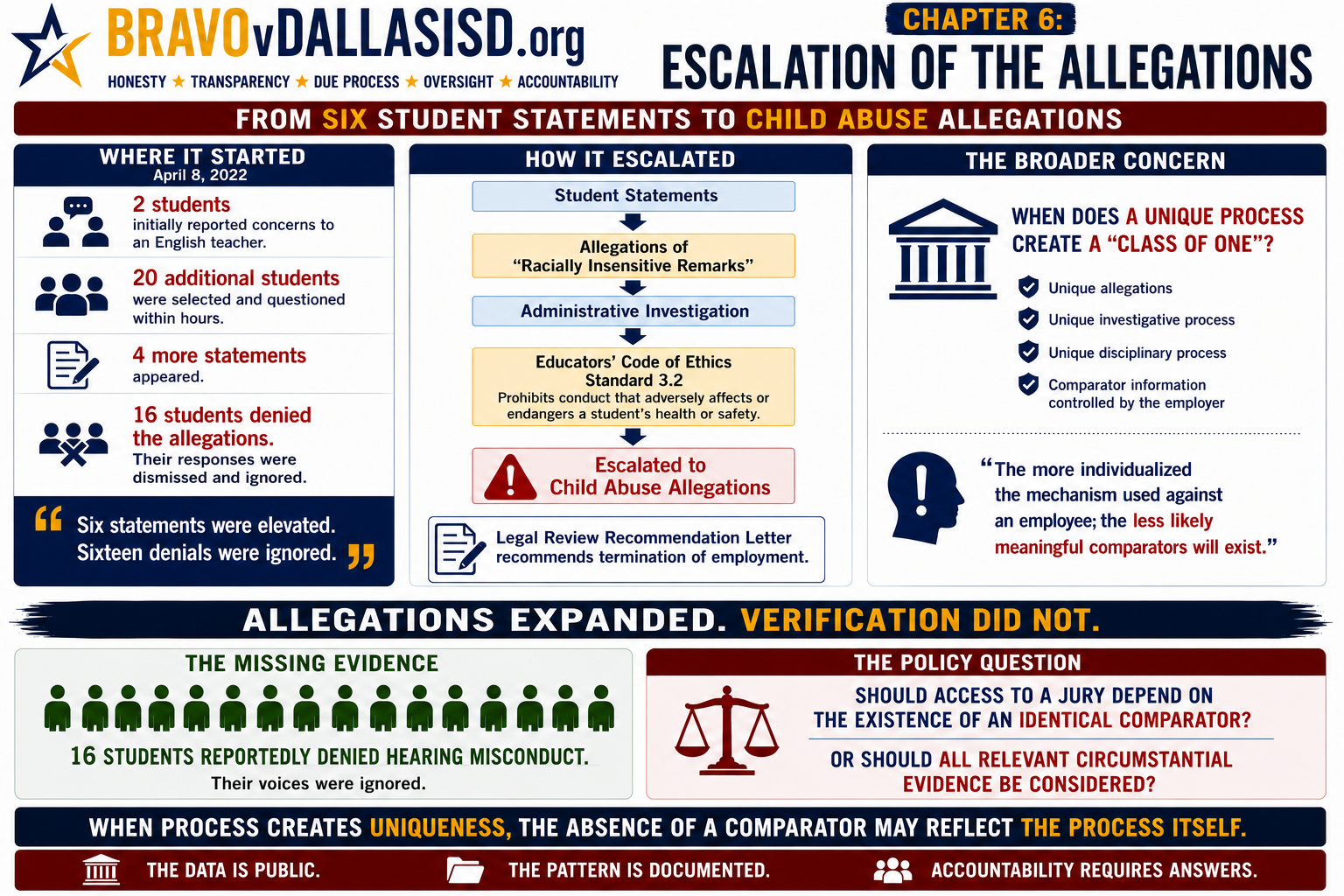
April 8, 2022 began like any other. But by that afternoon, two students, friends from the previous year’s class, leveled accusations to an English teacher that I had made racially insensitive remarks in class. Within hours, the assistant principal, selected twenty more students to question and four more statements appeared. One from another friend, again from the previous year’s class, and three friends from a current class. The sixteen students who denied the allegations were dismissed and their responses were ignored. The allegations of making racially insensitive remarks in class in the six statements were then expanded by administrators into allegations of child abuse citing Educators’ Code of Ethics Standard 3.2 – “The educator shall not intentionally, knowingly, or recklessly treat a student or minor in a manner that adversely affects or endangers the learning, physical health, mental health, or safety of the student or minor.” See Legal Review Recommendation Letter.
The evidence raises a broader concern. When an institution directs adverse treatment toward a uniquely situated employee, employs a unique investigative process, and controls access to comparator information, it effectively creates a "class of one." Under those circumstances, the absence of a comparator becomes a product of the process itself rather than evidence that discrimination did not occur. The more individualized the mechanism used against an employee; the less likely meaningful comparators will exist.
The concern extends beyond this case. Across much of the country, employees may survive summary judgment by presenting substantial circumstantial evidence from which a jury could infer discrimination. Yet under the approach applied here, a uniquely situated employee may lose access to a jury before that evidence is ever evaluated simply because no similarly situated comparator exists. This raises a broader public-policy question: should the practical availability of federal civil-rights protections depend upon whether an employer's conduct produced an identical comparator?