
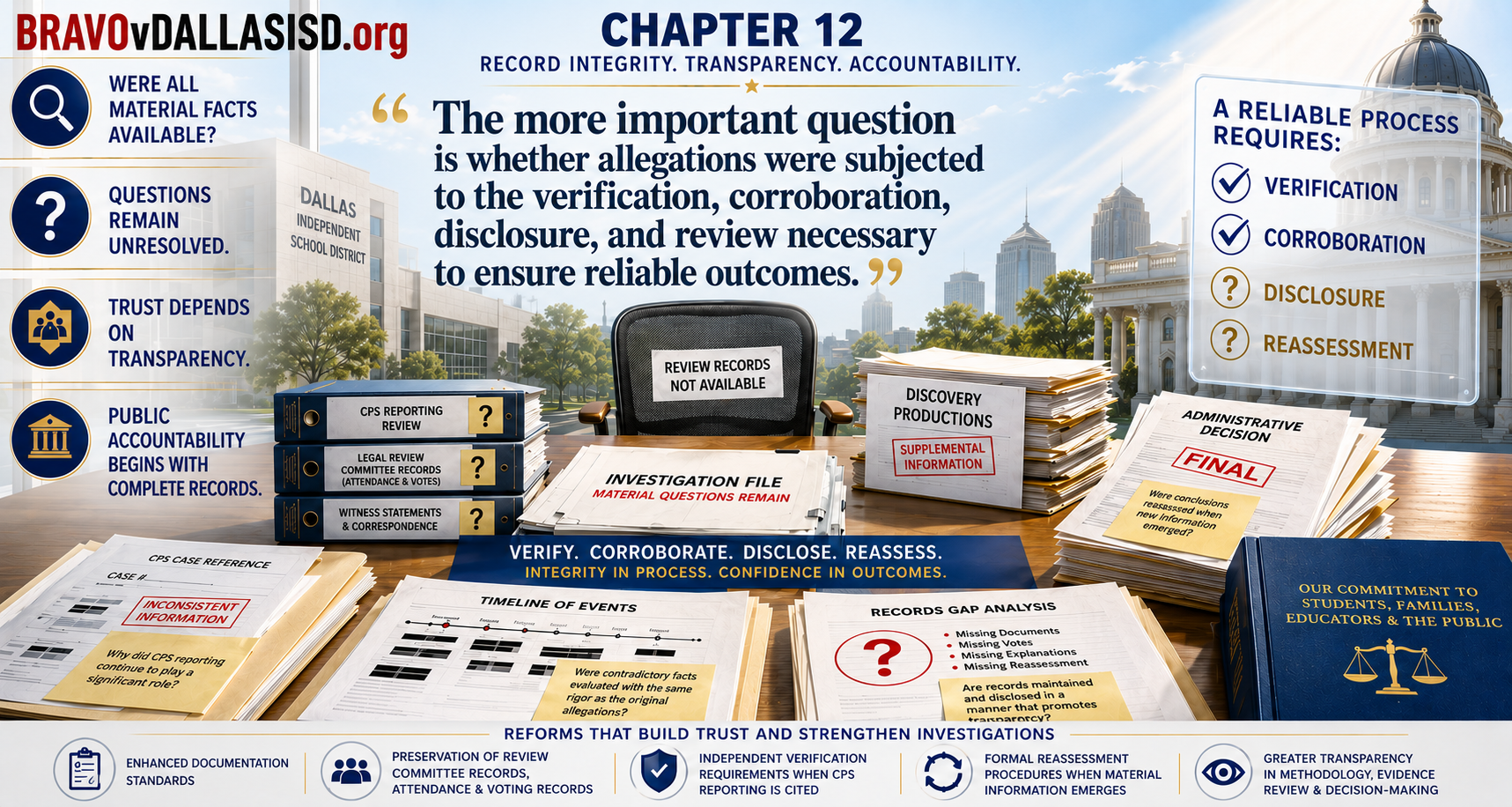
The Importance of Accurate and Complete Records
Public confidence in disciplinary proceedings depends upon the accuracy, completeness, and transparency of the records used to support administrative decisions. When serious allegations lead to termination recommendations, professional reporting, or reputational harm, the integrity of the supporting record becomes critically important.
This review does not ask readers to determine whether any individual acted with improper intent. Rather, it examines whether the available records, disclosures, and explanations provide a complete and reliable basis for the actions taken.
Documented Record Discrepancies
The record contains several areas where available documents, testimony, correspondence, and subsequent disclosures appear difficult to reconcile.
Among the questions raised by the record are:
-
Why CPS-related reporting continued to play a significant role in the disciplinary process despite later information concerning the referenced case number and reporting documentation.
-
Why records describing the Legal Review Committee process were limited, despite references to unanimous review and approval.
-
Why contradictory information that emerged during discovery did not result in a documented reassessment of earlier conclusions.
-
Why supplementary declarations and later explanations addressed some issues while leaving other material questions unresolved.
The existence of these questions does not establish wrongdoing. However, they remain relevant to evaluating the reliability of the process and the decisions that followed.
Questions Raised by the Record
The record raises several issues that independent reviewers may wish to consider:
-
Were all material facts available to decision-makers at the time disciplinary decisions were made?
-
Were contradictory facts and later-discovered information evaluated with the same rigor as the original allegations?
-
Were records maintained and disclosed in a manner that promoted transparency and meaningful review?
-
Were existing conclusions periodically reassessed when new information became available?
-
Did the process provide sufficient safeguards to ensure that administrative decisions remained tied to verified facts rather than untested assumptions?
These questions concern process integrity rather than the conduct of any particular individual.
Public Accountability and Institutional Trust
Public institutions depend upon confidence that serious allegations will be investigated thoroughly, documented accurately, and reviewed independently. When significant questions remain unresolved, public confidence can be diminished regardless of the ultimate outcome.
The central concern presented by this record is not whether allegations were made. Allegations occur in every large organization. The more important question is whether those allegations were subjected to the verification, corroboration, disclosure, and review procedures necessary to ensure accurate and reliable outcomes.
Recommended Reforms
To strengthen confidence in future investigations, consideration should be given to:
-
Enhanced documentation standards for serious misconduct investigations.
-
Preservation of all review committee records, attendance records, and voting records.
-
Independent verification requirements when CPS reporting is cited as a basis for disciplinary action.
-
Formal reassessment procedures when material contradictory information emerges.
-
Greater transparency regarding investigative methodology, evidence review, and final decision-making.
These reforms would benefit students, families, teachers, administrators, and the public by promoting transparency, accountability, and confidence in institutional decision-making.