
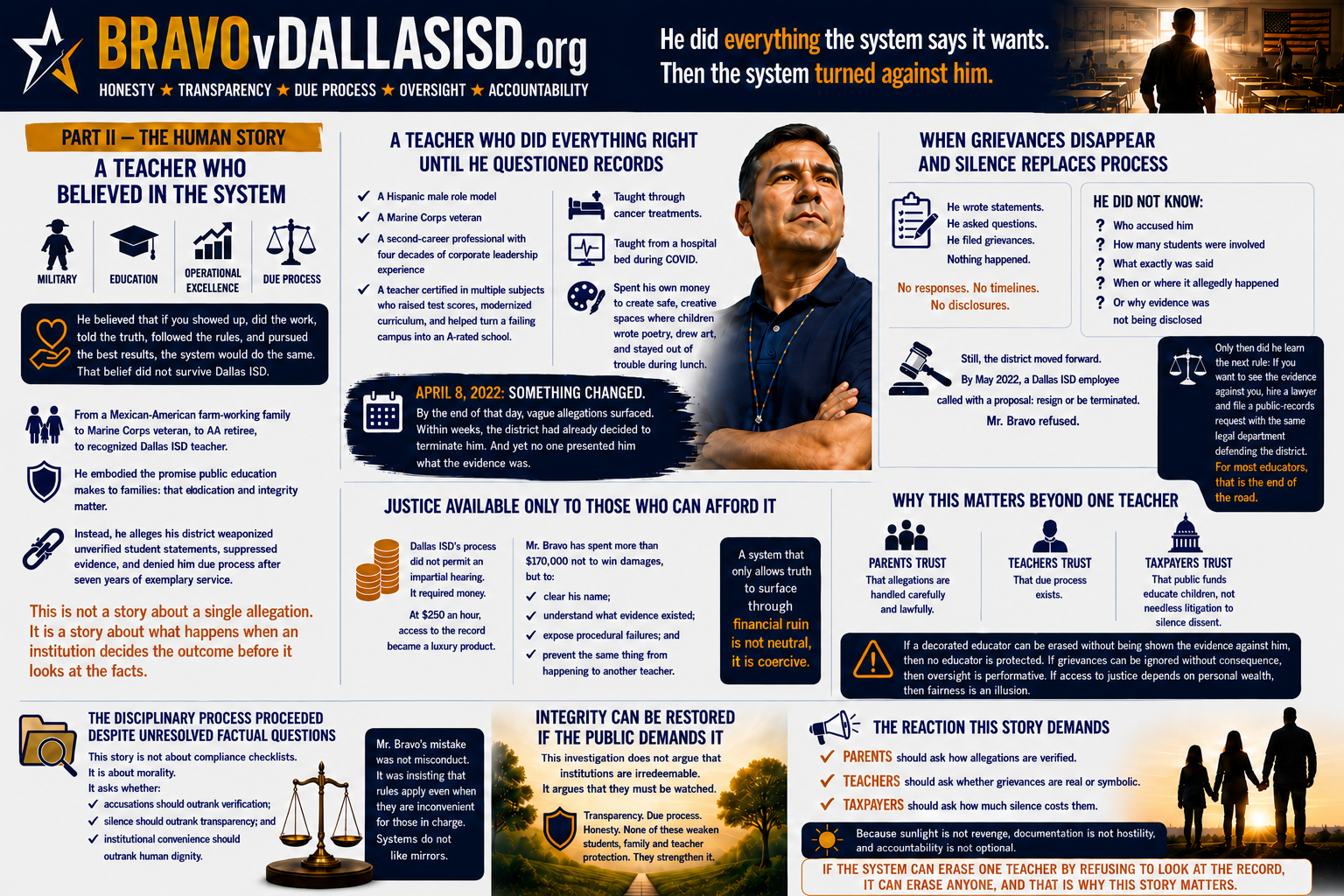
A Teacher Who Believed in the System
For most of my life, I believed in institutions.
I believed that hard work mattered. I believed that honesty mattered. I believed that if people followed the rules, treated others fairly, and acted with integrity, the systems around them would eventually reach the right result. Those beliefs were shaped by my family, strengthened through military service, reinforced during decades in corporate leadership, and carried into the classroom when I became a teacher.
Teaching was never simply a job. It was an opportunity to give something back.
Like many educators, I invested far more than what appeared on a paycheck. I invested time, energy, creativity, and a genuine desire to help young people discover possibilities they may never have considered for themselves. The greatest rewards were never awards or evaluations. They were the moments when students gained confidence, overcame obstacles, or began believing in their own potential.
That is why what followed was so difficult to understand.
The most painful part was not the professional consequences. It was the realization that obtaining answers required far more effort than receiving the accusations themselves. Questions that seemed simple remained unanswered. Requests for information produced more delays than clarity. The search for basic facts became a years-long journey through administrative procedures, legal processes, and public-records requests.
Over time, the experience transformed from a personal struggle into something larger.
What began as an effort to understand decisions affecting my own career evolved into a broader effort to understand how public institutions respond when citizens ask difficult questions. I discovered that persistence can be expensive, transparency can be elusive, and accountability often depends upon whether someone is willing and able to continue asking questions long after most people would have given up.
Yet this story is not ultimately about one educator, one district, or one dispute.
It is about trust.
Parents trust schools with their children. Teachers trust that professionalism and fairness will guide important decisions. Taxpayers trust that public institutions will operate transparently and responsibly. Those relationships depend upon confidence that facts matter, that questions are allowed, and that oversight functions as intended.
The human story is therefore not a story of defeat. It is a story of persistence. It is the story of refusing to stop searching for answers, even when doing so becomes difficult, costly, and unpopular. It is the belief that transparency strengthens institutions rather than weakens them, that accountability serves the public interest, and that fairness remains worth pursuing even when the outcome is uncertain.
At its core, this is simply the story of one citizen who believed the system would correct itself when presented with the facts—and who learned that meaningful accountability often requires ordinary people to insist upon it.