
Against 651 Who Heard Nothing
When truth is replaced by convenience, institutions don’t just fail individuals, they endanger everyone. This investigation examines how six unverified student statements, out of approximately 657 classmates, were elevated into accusations of “child abuse” without the most basic safeguards of verification, parental notification, or independent review and how that failure exposes a systemic vulnerability in public education governance.
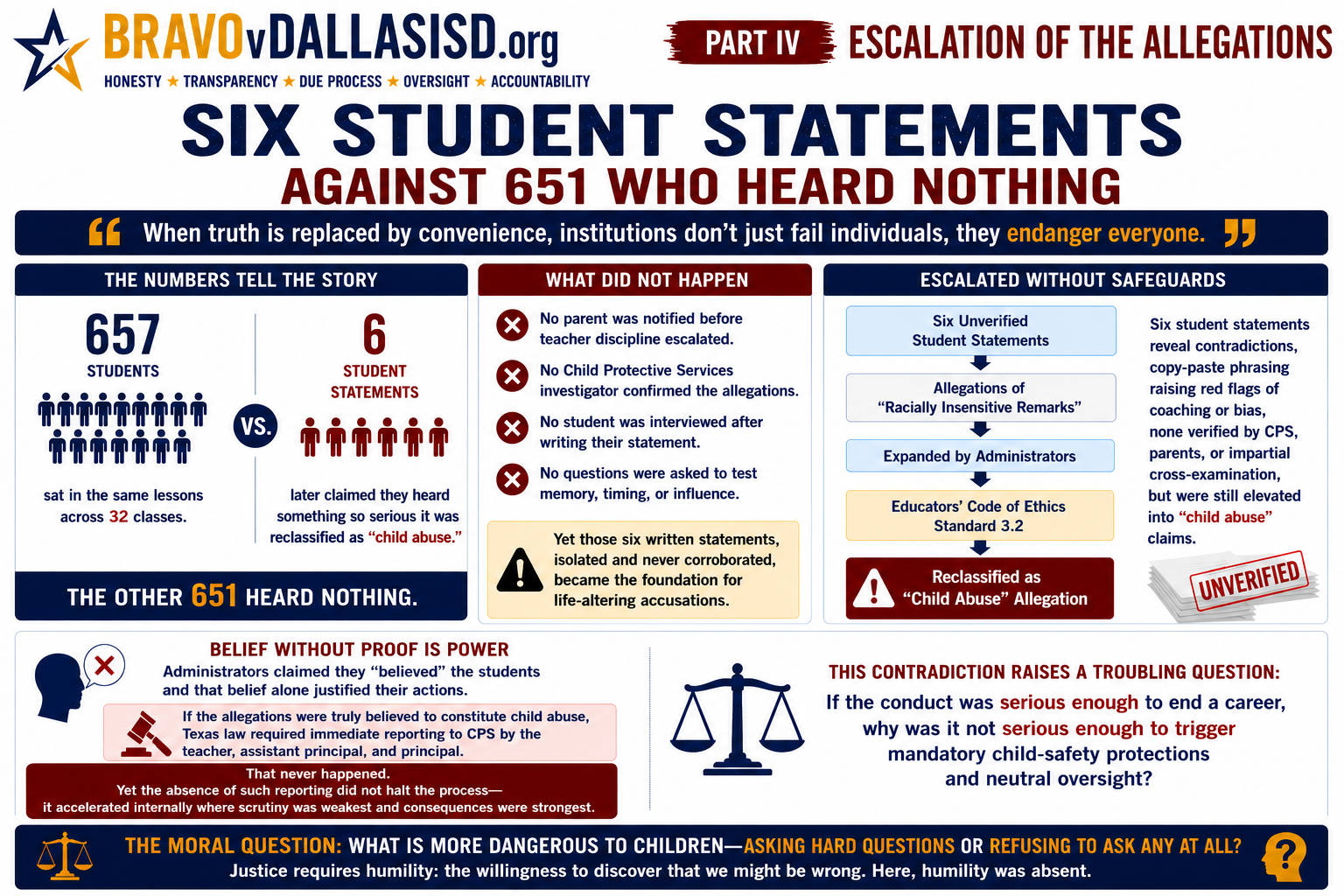
In a middle school serving one of Dallas’s most economically challenged communities, 657 students sat through the same lessons across thirty-two classes. Only six later claimed they heard something so serious it was reclassified as child abuse. The other 651 heard nothing.
No parent was notified before teacher discipline escalated. No Child Protective Services investigator confirmed the allegations. No student was interviewed after writing their statement. And no questions were asked to test memory, timing, or influence.
Yet those six written statements, isolated, and never corroborated became the foundation for life-altering accusations. That imbalance is not a coincidence. It is the story.
Six student statements reveal contradictions, copy-paste phrasing raising red flags of coaching or bias, none verified by CPS, parents, or impartial cross-examination, but were still elevated into “child abuse” claims. Readers are drawn into the unsettling question: how were so few voices that were never vetted or corroborated, elevated over 651 others who heard nothing to become absolute truth, and who benefited when the rest were ignored?
What the Records Reveal
An examination of the investigative record shows something striking, not what was done, but what was not done. According to the documents, once the six written statements were collected, the record does not reflect any meaningful follow-up questioning after the statements were collected. There was no effort to determine:
-
whether students wrote independently or after discussion;
-
whether similar phrasing suggested coaching or cross-contamination;
-
whether parents were consulted before statements were drafted;
-
whether the alleged statements were contextualized within lesson plans; or
-
why no contemporaneous complaint had been made when the remarks were supposedly “daily” for two years.
This is not a technical oversight. It is a significant departure from standard investigative practice. Established protocols used by school districts, civil-rights investigators, and child-welfare agencies require exactly the kinds of follow-up questions that were never asked here, questions designed to separate misunderstanding from misconduct, influence from memory, and narrative from fact.
Belief Without Proof
Administrators claimed they “believed” the students and that belief alone justified their actions. But belief, without verification, is not protection. It is power. If the allegations were truly believed to constitute child abuse, Texas law required immediate reporting including student identities and parental contact information to CPS by the teacher, assistant principal, and principal the allegations were reported to. That never happened. Yet the absence of such reporting did not halt the process, it accelerated it internally where scrutiny was weakest and consequences were strongest.
This contradiction raises a troubling question: If the conduct was serious enough to end a career, why was it not serious enough to trigger mandatory child-safety protections and neutral oversight?
Why It Matters Beyond One Teacher
This story is not about guilt or innocence. It is about process. If six unvetted statements can outweigh hundreds of silent witnesses; if accusations can be escalated without parental notice or independent confirmation; if confidentiality rules meant to protect children can instead shield institutions, then any educator in any district is vulnerable. And so are students. Because when allegations are not verified, real harm is never measured, false harm is never corrected, and trust in legitimate reporting collapses. Parents lose confidence. Teachers grow fearful. Students learn that truth depends not on facts, but on who controls the findings.
Public education cannot function under those conditions.
The Moral Question
At its core, this case asks a simple but profound question: What is more dangerous to children, asking hard questions or refusing to ask any at all? When systems stop testing allegations for fear of what they might uncover, they abandon their moral duty.
Justice requires humility: the willingness to discover that we might be wrong. Here, humility was absent.
Leads for Further Investigation
For reporters, regulators, and the public, the record points to clear next steps:
-
Expand confirmation from DFPS regarding the absence of any statutorily compliant CPS report in the district’s records.
-
Determine whether parents were notified and afforded an opportunity to provide relevant information before being sued for libel.
-
Determine whether the allegations were subjected to the follow-up verification, corroboration, and fact-finding measures typically associated with serious misconduct investigations.
-
Compare the six statements for linguistic similarities suggesting coordination.
-
Examine why no effort was made to record denials by the other students present.
-
Review how often similar allegations bypass CPS across the district.
These questions do not threaten student safety. They protect it.
How Fairness and Verification Can Be Restored
Experts in education law and child protection consistently point to the same safeguards, none of which were used here:
-
Mandatory Corroboration
Any student statement used for discipline must be accompanied by parental notification and documented CPS confirmation when abuse is alleged. -
Transparent Review
Redacted investigative interviews should be releasable for independent comparison, showing consistency or contradiction across accounts. -
Independent Oversight
A standing review panel of educators, parents, and legal experts should evaluate serious allegations before careers or reputations are destroyed.These are not radical reforms. They are baseline protections.
The Reaction This Story Demands
This investigation challenges readers, parents, teachers, trustees, and taxpayers to ask whether silence is safer than scrutiny. It is not. Because when verification disappears, administrative discretion fills the gap. And unchecked authority, does not protect children. It protects itself.