
See The Six Student Statements.
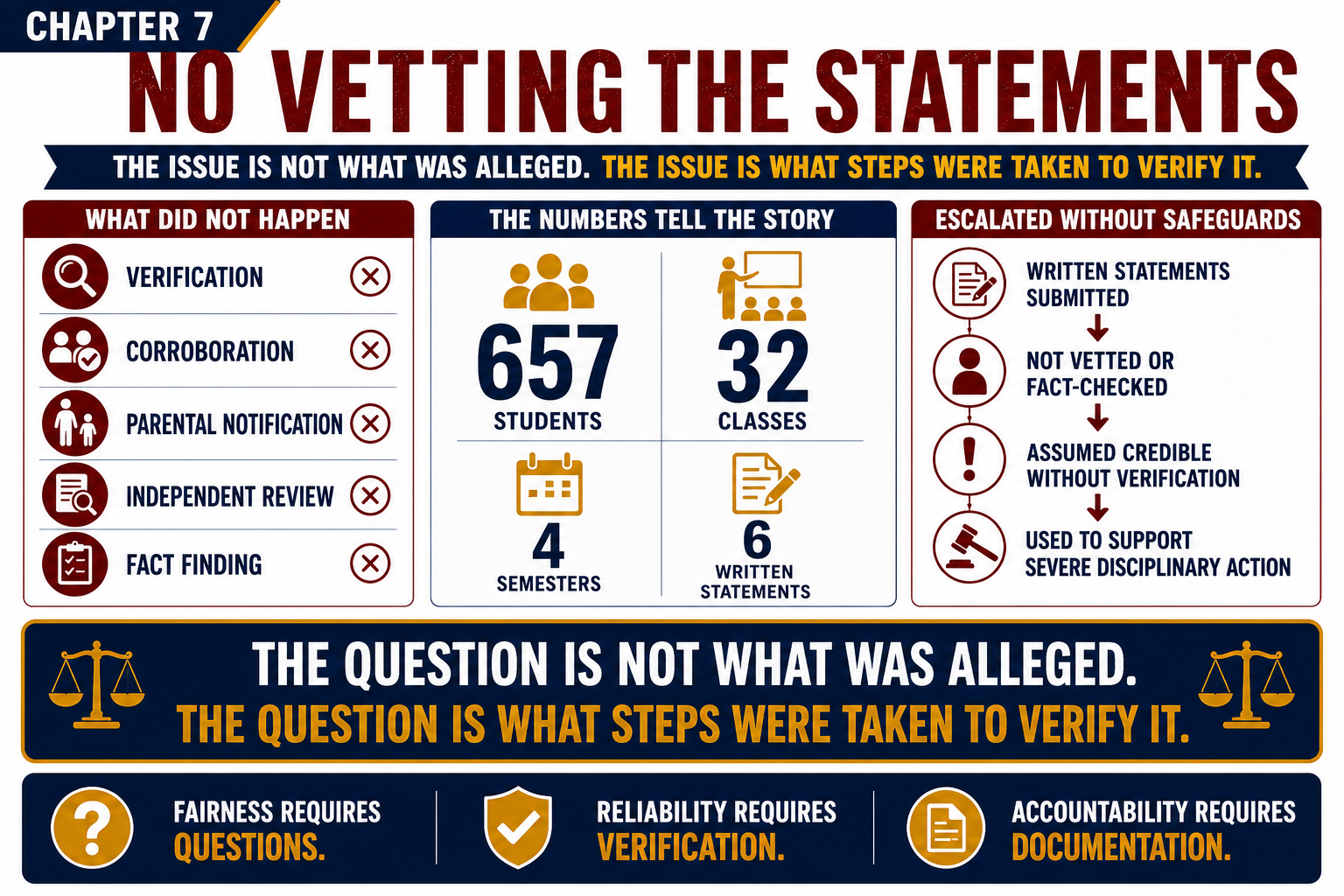
The central question is not what six students alleged. The central question is whether district officials subjected those allegations to the verification, corroboration, parental notification, independent review, and fact-finding measures ordinarily expected before relying upon them to support severe disciplinary action.
Not a single standard investigative question, much less the multiple fact-finding and corroborative questions outlined in District, EEOC, or TEA protocols was asked of any of the six students after their written statements were submitted. The investigator failed to probe for factual details or timing, and made no effort to test the reliability or independence of each student’s account.
Considering I delivered the same lectures over four semesters to 32 classes, including 657 students without any complaints, no one sought information that would explain the six statements indicating the allegations were repeated to the whole class throughout each semester but only the six heard them and the other 651 students did not?
Instead of individualized questioning designed to identify inconsistencies, the process
relied on unverified written statements and conclusory assumptions of credibility. These
omissions may be relevant to assessing the investigation’s integrity. In the end, the record
does not appear to document follow-up efforts to verify witness recollections, assess
consistency among accounts, evaluate alternative explanations, review relevant instructional
context, obtain parental input, or reconcile conflicting information. These omissions may be
relevant to assessing the completeness, reliability, and fairness of the investigative
process.