
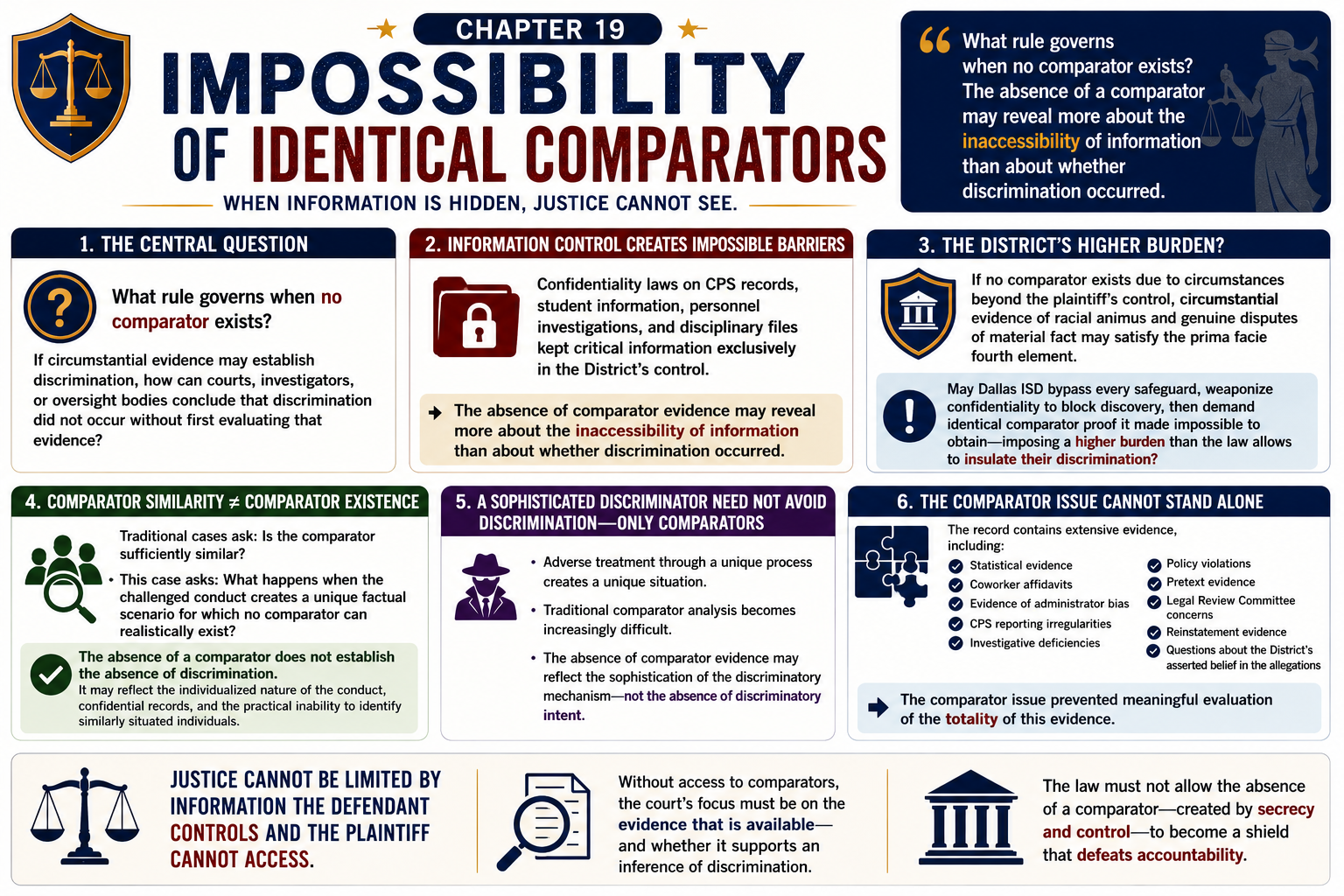
The central question is straightforward: What rule governs when no comparator exists? If circumstantial evidence may establish discrimination, how can courts, investigators, or oversight bodies conclude that discrimination did not occur without first evaluating that evidence?
The practical difficulty of identifying identical comparators was compounded by confidentiality laws governing CPS records, student information, personnel investigations, and disciplinary files. Much of the information necessary to determine whether similarly situated individuals existed remained exclusively within the District's control. Thus, the absence of comparator evidence may reveal more about the inaccessibility of the information than about whether discrimination occurred.
If a similarly situated teacher cannot be identified because of circumstances beyond the control of the plaintiff, circumstantial evidence of racial animus and genuine disputes of material fact may satisfy the prima facie fourth element. At issue is whether Dallas ISD may bypass every safeguard designed to ensure honesty, transparency, compliance, due process, oversight, and accountability; weaponize confidentiality to block discovery; then demand identical comparator proof it made impossible to obtain. Does the District’s imposition of an identical comparator requirement contradict precedents and impose a higher burden than the law allows to insulate their discrimination?
A critical distinction also exists between comparator similarity and comparator existence. Traditional employment-discrimination cases ask whether a proposed comparator is sufficiently similar to permit a meaningful comparison. This case presents a different question: what happens when the challenged conduct itself creates a unique factual scenario for which no comparator can realistically exist? The absence of a comparator does not establish the absence of discrimination. It may instead reflect the individualized nature of the challenged conduct, the confidentiality of investigative records, and the practical inability to identify similarly situated individuals.
A troubling implication follows. A sophisticated discriminator need not avoid discrimination; he need only avoid comparators. When adverse treatment is directed toward a uniquely situated individual through a unique process, traditional comparator analysis becomes increasingly difficult. Under such circumstances, the absence of comparator evidence may reflect the sophistication of the discriminatory mechanism rather than the absence of discriminatory intent.
The comparator issue should not be viewed in isolation. The record contained statistical
evidence, coworker affidavits, evidence of administrator bias, CPS reporting irregularities,
investigative deficiencies, policy violations, pretext evidence, Legal Review Committee
concerns, reinstatement evidence, and questions regarding the District's asserted belief in
the allegations. The significance of the comparator issue is that it prevented meaningful
evaluation of the totality of that evidence.